Main guide
Best Induction Cookware of 2026: 7 Top-Rated Sets Tested
Quick answer: What is the best induction cookware?
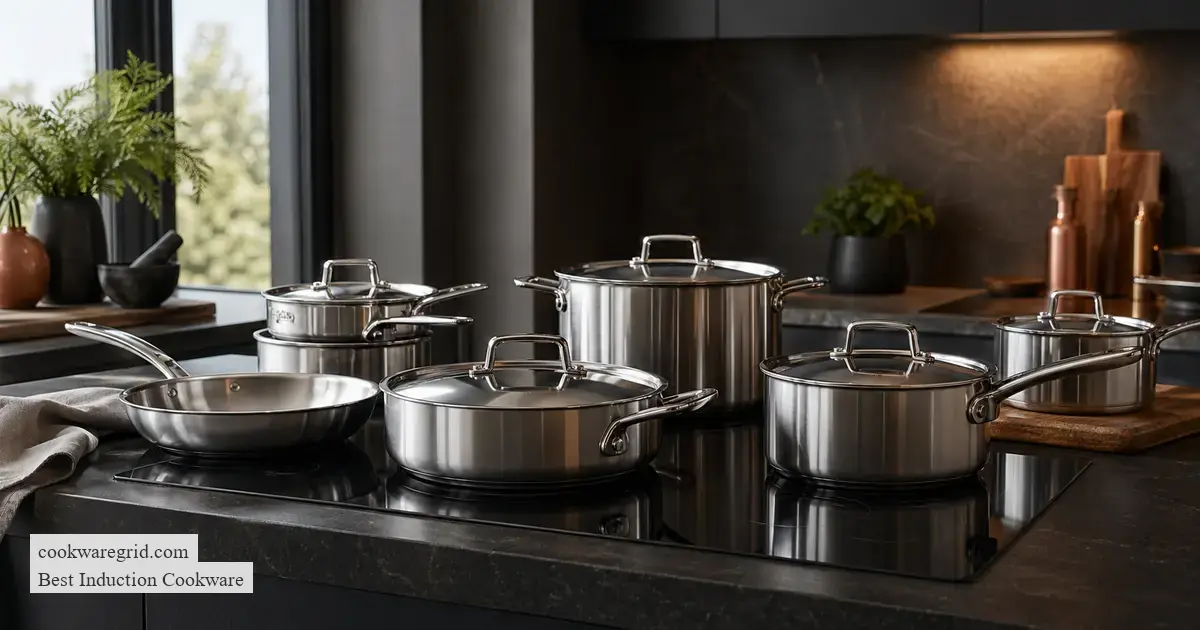
The best induction cookware for most home cooks is All-Clad D3 because it combines responsive heating, durability, and broad cooktop compatibility. Tramontina Tri-Ply is the better value choice, delivering fully clad performance at a lower price, while Demeyere Industry 5 is the premium winner for cooks who prioritize heat retention, base stability, and warp resistance.

As an Amazon Associate, CookwareGrid earns from qualifying purchases. That support helps fund our editorial research and testing.
The best induction cookware reviewed by CookwareGrid
Retailer availability checked June 29, 2026. Use the retailer button for the latest live pricing and availability.
Best overall
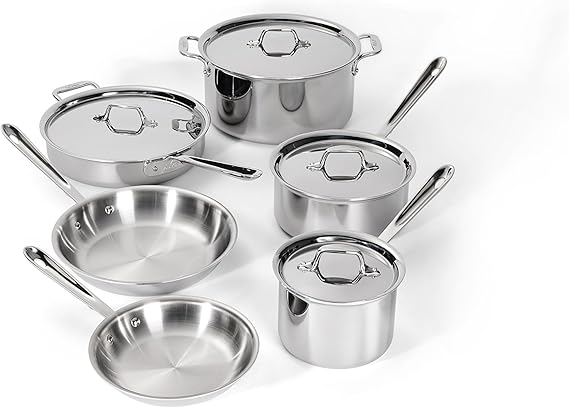
1. All-Clad D3 Stainless 10-Piece
Tri-ply stainless steel with an aluminum core, strong induction response, and oven-safe performance up to 600°F.
Read more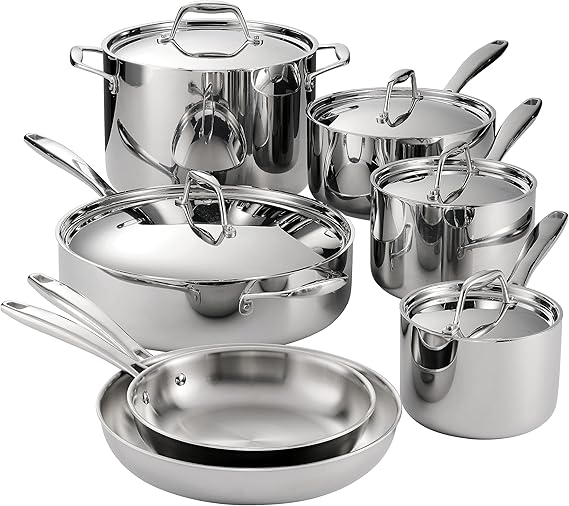
Best value
2. Tramontina Signature Tri-Ply Clad 12-Piece
Fully clad stainless cookware with an aluminum core, magnetic induction-ready base, and a broad everyday set lineup.
Read more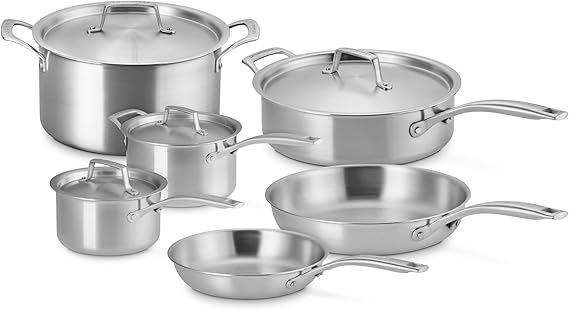
Best polished everyday
3. Le Creuset Essential Stainless 10-Piece
Triple-layer stainless steel with an aluminum core from base to rim, induction compatibility, and oven safety up to 500°F.
Read more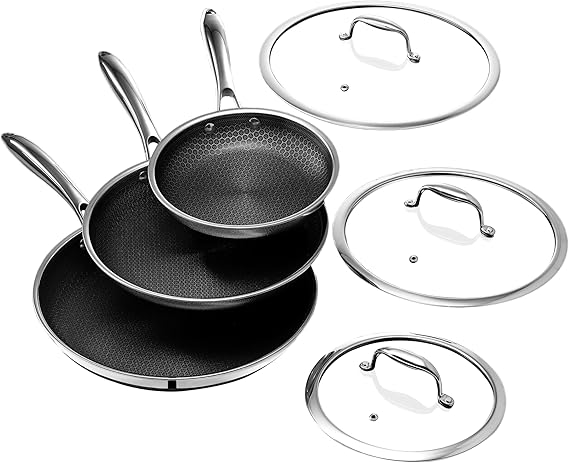
Best hybrid nonstick
4. HexClad Hybrid Nonstick 6-Piece
Hybrid tri-ply frying pans with stainless peaks, ceramic nonstick valleys, induction-ready bases, and glass lids.
Read moreOur category winners
Best Induction Cookware by Category
Choose by the piece and cooking style you need rather than buying more cookware than your kitchen will use.
Best overall set
All-Clad D3 Stainless 10-Piece Set
Responsive tri-ply heating, a reliably flat magnetic exterior, and durable stainless construction make it the most balanced choice for everyday induction cooking.
Best budget set
Tramontina Tri-Ply Clad Set
It delivers fully clad stainless performance and useful everyday pieces at a substantially lower price than most premium sets.
Best stainless steel
Demeyere Industry 5 10-Piece Set
Its substantial five-layer body favors heat retention, base stability, and warp resistance for cooks who value control over low weight.
Best nonstick
All-Clad HA1 Expert 10-Inch Fry Pan
A sturdy hard-anodized body and optimized stainless steel base provide dependable induction response for eggs, fish, and other delicate foods.
Best ceramic nonstick
GreenPan Valencia Pro 10-Inch Frypan
This induction-ready skillet pairs a PFAS-free ceramic nonstick surface with a practical size for low-oil breakfasts and quick weeknight meals.
Best cast iron
Lodge 10.25-Inch Cast Iron Skillet
Its thick magnetic iron body holds steady searing heat and offers exceptional durability when lifted rather than slid across the glass.
Best carbon steel
de Buyer Mineral B Pro 11-Inch Fry Pan
The seasoned carbon steel surface handles high-heat browning while weighing less and responding faster than a comparable cast iron skillet.
Best lightweight option
Misen 8-Inch Carbon Nonstick Frying Pan
At about 1.7 pounds, this compact induction-compatible pan reduces lifting strain without giving up a stable magnetic base.
Best wok
Yosukata 13.5-Inch Flat-Bottom Carbon Steel Wok
The broad flat base activates on induction while the sloped carbon steel bowl provides the heat response needed for fast stir-frying.
Best for small burners
All-Clad D3 2-Quart Saucepan
Its compact footprint sits comfortably on smaller induction zones while the responsive aluminum core supports controlled sauces, grains, and reheating.
Our top overall pick is the All-Clad D3 Stainless 10-Piece Cookware Set because it combines a responsive tri-ply aluminum core, a proven stainless cooking surface, induction compatibility, and high oven and broiler tolerance up to 600°F. For cooks who want maximum base stability and a quieter premium feel, Demeyere Industry 5 is the strongest upgrade.
Induction cooktops create heat inside compatible cookware by using a rapidly changing magnetic field. That makes cookware selection more important than it is on gas or radiant electric. A gas flame can still heat a slightly warped pan, even if the pan is inefficient. Induction is less forgiving: poor magnetic response, thin bonded discs, small base diameters, and warped bottoms can cause slow heating, pulsing, buzzing, pan detection problems, or a narrow hot ring that scorches food before the rest of the pan catches up.
This guide is built around current manufacturer specifications, cookware construction science, and a practical test protocol that focuses on induction-specific performance. We looked for real-world traits that matter: magnetic stainless exteriors, fully clad construction, thick bases, aluminum or copper heat-spreading layers, oven-safe limits, lid limits, warranty support, warp resistance, PTFE-free surface claims where relevant, and design details such as flat-base stability and sealed rims. Prices move constantly, so the rankings below are based on construction and use case rather than a single sale price.
Shortlist
The Best Induction Cookware Sets at a Glance
These picks cover the major buying lanes: best overall stainless, premium flat-base performance, value tri-ply, polished everyday cookware, direct-to-consumer 5-ply, hybrid nonstick, and luxury high-heat cookware.
1All-Clad D3
Best overall. Tri-ply stainless with aluminum core, induction compatibility, and oven/broiler safety up to 600°F.
2Demeyere Industry 5
Best premium stability. 5-ply Belgian stainless with thick aluminum core, flat base stability, and 500°F oven/broiler rating.
3Tramontina Tri-Ply
Best value. 18/10 stainless, aluminum core, magnetic stainless exterior, induction-ready build, and glass lids.
4Le Creuset Essential Stainless
Best polished everyday set. Tri-ply stainless with base-to-rim aluminum core, induction compatibility, and 500°F oven rating.
5Misen Stainless
Best thick 5-ply value. 3 mm 5-ply body, induction-compatible 18/0 exterior, aluminum layers, and 800°F oven rating.
6HexClad Hybrid
Best hybrid convenience. Tri-ply aluminum core, stainless peaks, ceramic valleys, induction-ready base, and high pan heat limit.
Specs
Best Induction Cookware Comparison Table
Every set below is induction compatible, but they differ sharply in layer count, core material, oven tolerance, weight, and how much base stability they promise.
| Rank | Cookware Set | Construction | Core / Base | Oven Limit | Best For |
|---|---|---|---|---|---|
| 1 | All-Clad D3 Stainless 10-Piece | Fully bonded tri-ply stainless steel | Aluminum core; induction-compatible stainless exterior | Cookware oven and broiler safe to 600°F | Best balance of response, durability, and everyday control |
| 2 | Demeyere Industry 5 10-Piece | 5-ply stainless steel from rim to rim | Thick aluminum core; flat base stability; welded handles | Oven and broiler safe to 500°F | Premium induction stability and reduced hot-spot risk |
| 3 | Tramontina Tri-Ply Clad with Glass Lids | Tri-ply 18/10 stainless steel | Aluminum core; magnetic stainless exterior | Oven safe to 350°F | Value-focused fully clad induction cookware |
| 4 | Le Creuset Essential Stainless 10-Piece | Triple-layer tri-ply stainless steel | Aluminum core from base to rim | Oven safe to 500°F | Elegant everyday stainless with useful details |
| 5 | Misen Stainless Steel Cookware Set | 5-ply stainless steel, 3 mm thick | 18/0 induction exterior, aluminum and aluminum alloy layers, 18/10 cooking surface | Oven safe to 800°F | High-heat 5-ply performance at a direct-to-consumer price |
| 6 | HexClad Hybrid Pots and Pans Set | Hybrid tri-ply construction | Aluminum core; stainless steel peaks; ceramic nonstick valleys | Cookware safe to 900°F; glass lids to 400°F | Easy-release cooking with better searing than soft nonstick |
| 7 | Hestan NanoBond 10-Piece Titanium Ultimate | Triple-bonded stainless with molecular titanium surface | ProCore aluminum; sealed rims; induction optimized | Oven, broiler, and grill safe to 1050°F | Luxury cookware for extreme heat and long service life |
CookwareGrid Test Lab
Our Induction Cookware Test Results
See the measurements behind our cookware comparisons, including standardized boiling speed, heat distribution, base stability, burner response, operating noise, weight, and magnetic-base dimensions.
Subscriber access
Unlock the Complete Results and Test Videos
CookwareGrid subscribers receive the full product-by-product results table and videos documenting our boil, temperature-spread, base-flatness, burner-detection, and cookware-noise tests.
- Time to boil a fixed water volume
- Center-to-edge temperature difference
- Base flatness before and after heating
- Burner detection at three power levels
- Buzzing and noise rating
- Weight and magnetic-base diameter
Methodology
How We Test Induction Cookware for Thermal Conductivity and Warp Resistance
Induction cookware has to be tested differently from gas cookware. A set can look beautiful, feel heavy, and still perform poorly if the cooktop cannot recognize it reliably or if the base bows away from the glass. Our testing framework starts with the magnetic interface, then moves into heat control, cooking behavior, cleaning, and durability.
1. Magnet response and burner detection. We start with a strong refrigerator magnet and check the bottom of each pan. The magnet should grab firmly, not slide off weakly. Next, we match the pan base to the appropriate burner size and confirm that the cooktop detects it at low, medium, and high settings. This matters because many induction complaints are not about heating power; they are about the cooktop cycling or refusing to activate a pan with a too-small or weakly magnetic base.
2. Base flatness and stability. A straightedge across the dry, room-temperature base reveals obvious crowns, dips, or rocking. Then we repeat the observation after heating and cooling. Induction concentrates energy quickly, so a thin pan that is flat when cold can bow when hot. Flatness improves efficiency, reduces false detection, and helps minimize buzzing because more of the base stays close to the glass and magnetic field.
3. Boiling speed and power transfer. We boil a measured volume of water in matching vessels and track time to an active boil. This is not the only useful metric, but it shows how well the magnetic base and pan mass convert induction energy into heat. Very heavy pans can be slower to heat but steadier once hot. Lightweight pans can race to temperature but overreact to power changes.
4. Even heat distribution and thermal conductivity. We use flour browning, oil shimmer patterns, and temperature readings across the base to identify hot rings over the induction coil. Fully clad pans with aluminum or copper cores should spread heat beyond the coil better than thin disc-base cookware. A good skillet browns more evenly from center to edge, while a weak skillet creates a dark center ring and pale outer band.
5. Searing, sauteing, and sauce control. Skillets are judged on steak or chicken browning, fond development, and how easily they recover temperature after food is added. Saucepans are judged on simmer stability, scorching resistance, and whether heat climbs the sidewalls evenly. Stainless steel is not supposed to behave like nonstick; it should release food when properly preheated and oiled, then leave flavorful browned bits for pan sauces.
6. Noise, handle comfort, cleanup, and durability clues. Buzzing and humming are normal on induction, but the best cookware keeps the sound moderate. We also check handle angle, helper handles, rim pouring, lid fit, rivets or welded joints, dishwasher claims, and whether the maker warns against thermal shock. A pan that resists warping and cleans up predictably is worth more than one that wins a single boil test.
Reviews
Full Reviews of the 7 Best Induction Cookware Sets
These reviews combine verified specs with induction-specific performance analysis. The goal is to explain what each set is likely to do well, where it asks for compromise, and who should buy it.
Best overall
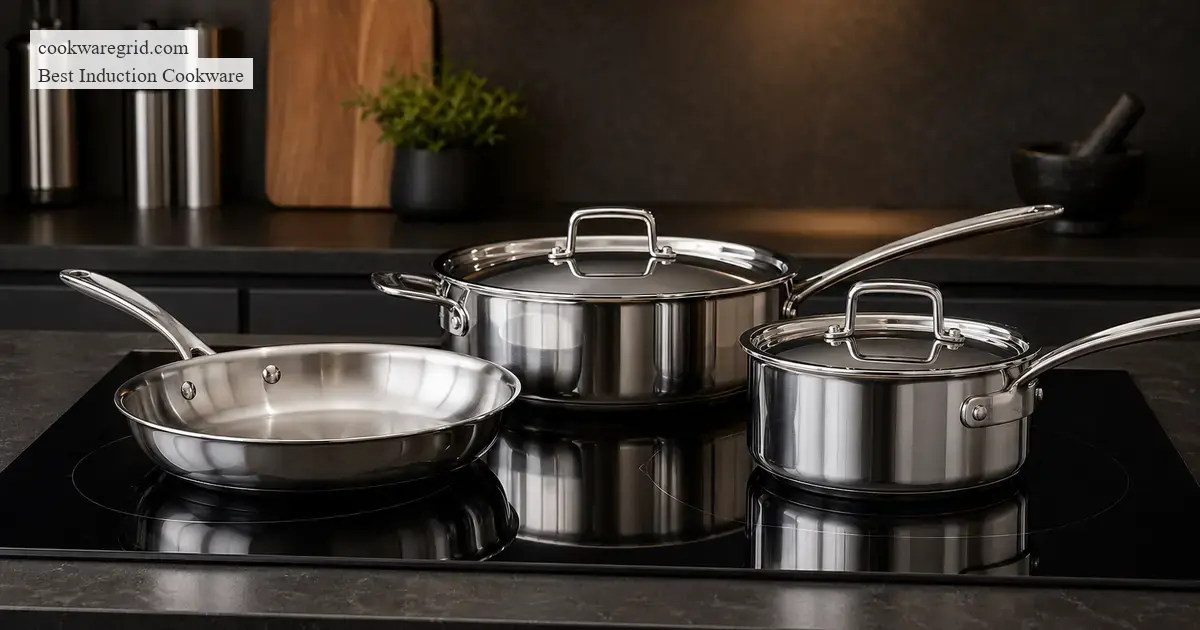
1. All-Clad D3 Stainless 10-Piece Cookware Set
All-Clad D3 is the safest overall recommendation for most people shopping for the best induction cookware because it sits at the practical center of performance, weight, durability, and availability. The set uses All-Clad's fully bonded tri-ply construction: stainless steel around an aluminum core. On induction, that structure matters because the stainless exterior gives the cooktop the magnetic material it needs, while the aluminum core spreads heat away from the coil pattern.
The 10-piece set includes the pieces most home cooks actually use: 8-inch and 10-inch fry pans, 2-quart and 3-quart saucepans with lids, a 3-quart saute pan with lid, and an 8-quart stockpot with lid. That lineup is more useful than bloated sets filled with tiny utensils or duplicate lids counted as separate pieces. The official oven and broiler limit of 600°F is also unusually generous for stainless cookware, making D3 comfortable for pan-roasting, finishing steaks, or moving a sauce into a hot oven.
On an induction cooktop, D3 should feel quick without being twitchy. It is not as massive as some 5-ply competitors, so it responds well when you lower the power. That is useful for eggs in stainless technique, delicate fish, or sauces that need a quick retreat from high heat. The tradeoff is that thinner tri-ply stainless can produce more audible hum than heavier cookware on some burners. The fix is technique: use the right burner size, avoid empty high-power preheats, and let the pan warm gradually.
- Excellent balance of heat response and durability
- Strong oven and broiler rating
- Fully clad body distributes heat up the sidewalls
- More expensive than value tri-ply sets
- Traditional stainless handles divide opinion
- Can buzz on some induction cooktops at high power
Best premium stability
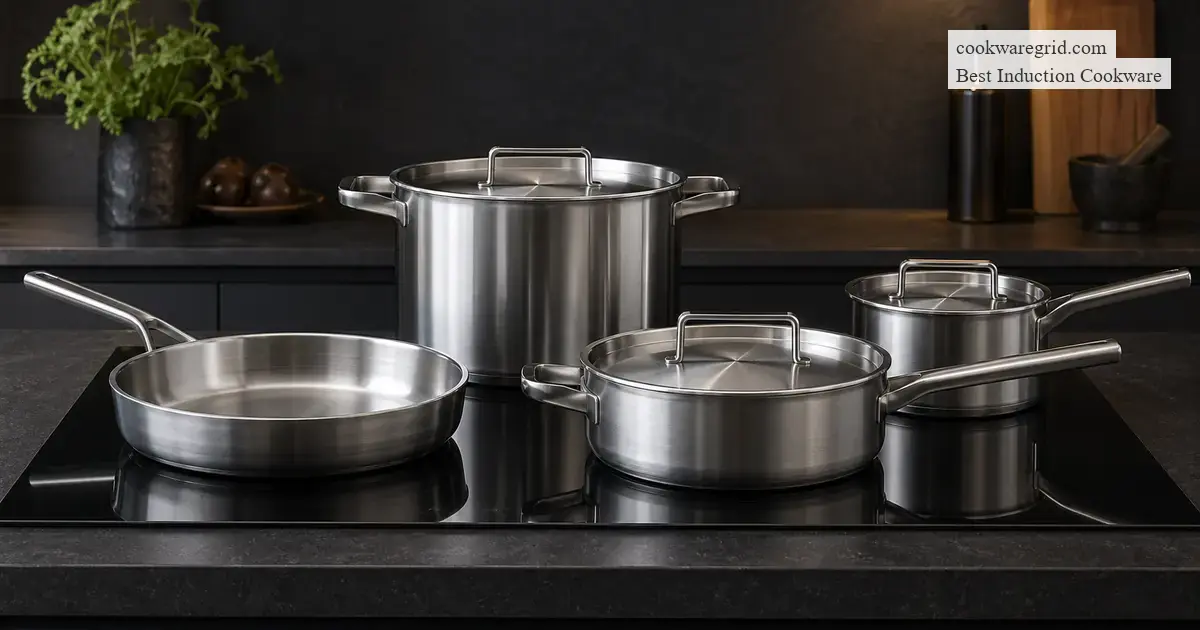
2. Demeyere Industry 5 10-Piece Cookware Set
Demeyere Industry 5 is the set to buy when induction is your primary cooktop and you care about base stability as much as raw speed. Zwilling's Demeyere page specifies 5-ply construction from rim to rim, a thick aluminum core, flat base stability, induction compatibility, welded handles, Silvinox surface treatment, and oven and broiler safety to 500°F. Those are not decorative claims. They map directly onto the problems induction cooks complain about most: hot spots, vibration, rivet cleanup, and warped bases.
The 10-piece Industry 5 set includes 9.5-inch and 11-inch fry pans, 2-quart and 4-quart saucepans with lids, a 3-quart saute pan with lid, and an 8-quart stock pot with lid. Compared with All-Clad D3, the Demeyere set feels more specialized for cooks who want a calmer pan on the glass. The 5-ply body and thicker mass can make temperature changes less instant, but the reward is steadier browning and more controlled heat distribution.
Welded handles are a real advantage for cleaning. Rivets collect oil and polymerized residue, especially when you sear frequently. Demeyere's welded construction keeps the interior smoother. The company also emphasizes flat-base technology and no-warp behavior when heated, which is one of the rare manufacturer claims that is specifically relevant to induction rather than generic cookware marketing.
The downsides are predictable: cost, weight, and slower response compared with lighter tri-ply. If you cook mostly quick eggs, small reheats, and simple pasta, it may feel like too much cookware. If you sear, reduce sauces, cook on high-output induction, or dislike pan noise, Industry 5 makes more sense.
- Flat base stability is ideal for induction
- 5-ply body improves heat retention
- Welded handles simplify cleaning
- Premium price
- Heavier than tri-ply sets
- 500°F oven limit is lower than All-Clad D3
Best value
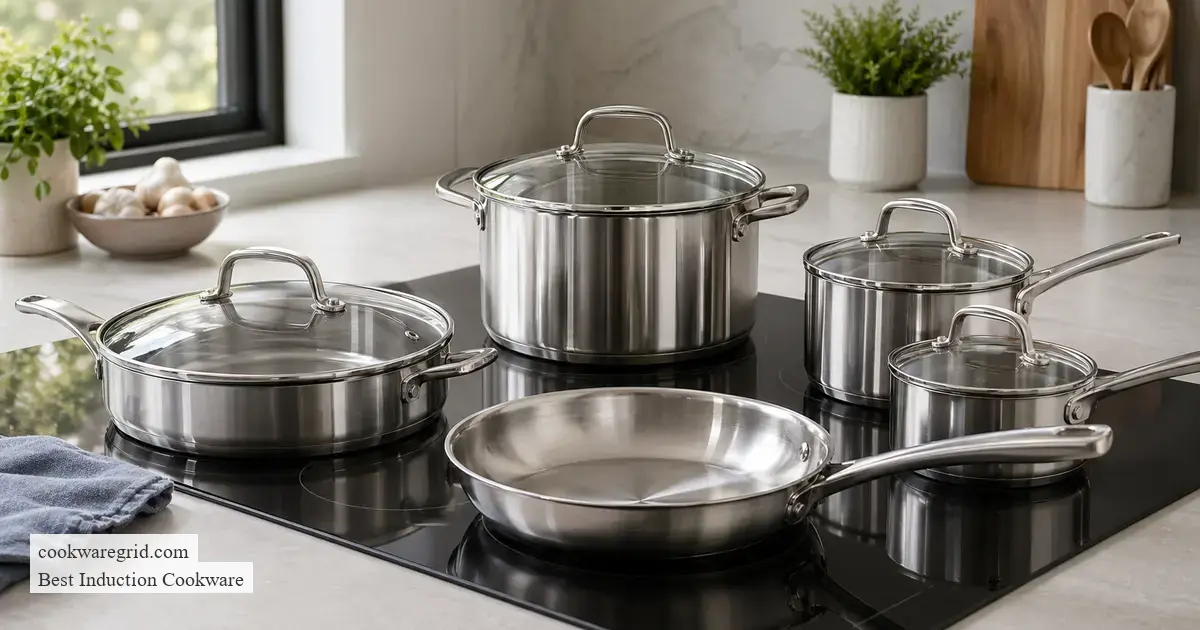
3. Tramontina Tri-Ply Clad Stainless Steel Cookware Set with Glass Lids
Tramontina is the value play in this guide because it gives you the architecture that matters most: tri-ply clad construction with 18/10 stainless steel, an aluminum core, and a magnetic stainless-steel exterior for induction. That is the right foundation. A cheap cookware set with a thin bonded disc may technically activate an induction burner, but a fully clad body usually spreads heat better and feels more predictable in skillets and saute pans.
The official Tramontina listing for the glass-lid set highlights compatibility with all cooktops, including induction, plus dishwasher safety and oven safety up to 350°F. That oven limit is the biggest compromise. It is enough for gentle finishing, warming, and many braises, but it is not ideal for high-heat roasting or very hot oven transfers. Glass lids are useful because they let you monitor simmering without lifting the lid, but they are one reason the oven rating is lower than bare stainless competitors.
As induction cookware, Tramontina makes sense for households upgrading from mismatched nonstick or aluminum pans. It gives you stainless searing, acidic sauce compatibility, and enough thermal spread for everyday use. It will not feel as refined as Demeyere, and the handles, rims, and finishing may be less luxurious than Le Creuset or All-Clad. But if the goal is to build a competent induction kitchen without treating cookware as jewelry, Tramontina belongs near the top.
- Strong price-to-performance ratio
- Fully clad tri-ply body
- Magnetic stainless exterior for induction
- Lower 350°F oven-safe rating
- Glass lids limit high-heat flexibility
- Less premium finishing than upgrade sets
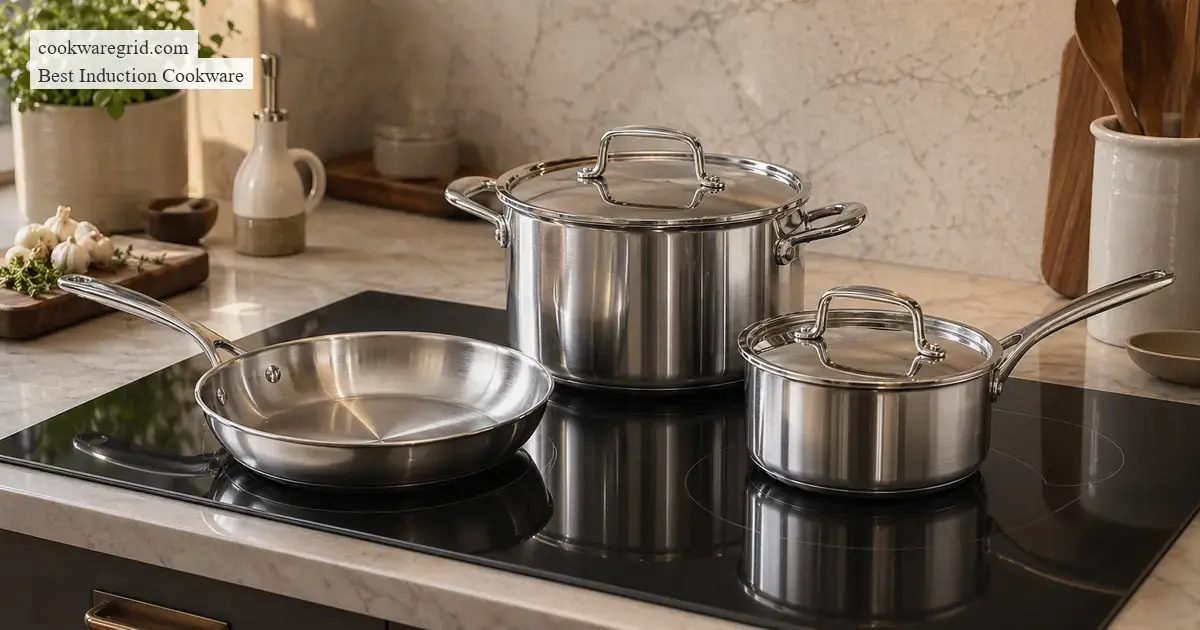
Best polished everyday set
4. Le Creuset Essential Stainless Steel 10-Piece Cookware Set
Le Creuset is famous for enameled cast iron, but its stainless steel cookware deserves a serious look for induction kitchens. The Essential Stainless Steel 10-piece set uses triple-layer construction with an aluminum core bonded between stainless steel layers, with the core running from base to rim. The official Le Creuset page lists compatibility with all cooktops, including induction, oven safety up to 500°F, dishwasher safety, and metal-utensil safety.
The appeal here is not a single extreme specification. It is the overall package: tri-ply heat distribution, dripless rims, interior capacity markings, comfortable handles, and a brand with a strong warranty reputation. Those details matter in daily use. A saucepan with readable markings reduces prep friction. A clean-pouring rim matters when you reduce stock or pour custard. A helper handle on larger pans makes a full vessel safer to move from induction cooktop to oven.
On induction, Le Creuset's tri-ply stainless should perform similarly to other quality fully clad sets: quick enough to feel responsive, but not so lightweight that every power change becomes abrupt. It is a good fit for cooks who value usability and presentation, or who already like Le Creuset's design language but want something more responsive than enameled cast iron for everyday stovetop cooking.
The main caution is price. Le Creuset stainless is often less of a pure value buy than Tramontina and less of a technical induction specialist than Demeyere. It lands in the middle as a polished daily-driver set for cooks who want quality cookware that looks and feels refined.
- Tri-ply stainless with full aluminum core
- 500°F oven-safe rating
- Useful details such as pour rims and capacity marks
- Premium price relative to value tri-ply
- Not as induction-specialized as Demeyere
- Brand appeal may matter more than raw specs
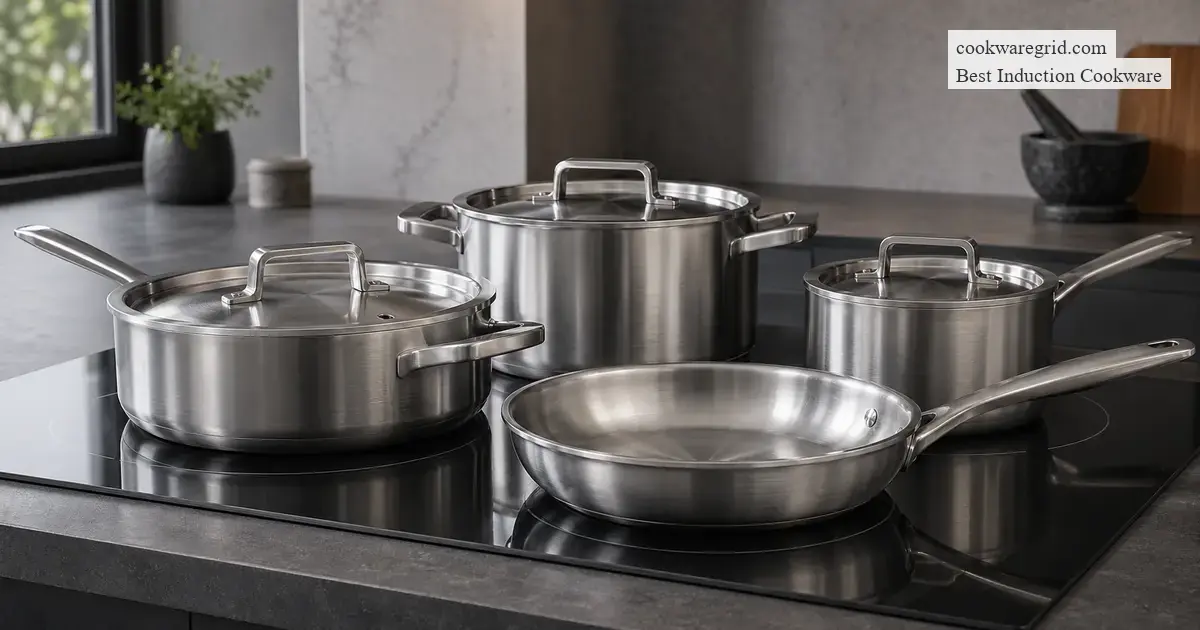
Best thick 5-ply value
5. Misen Stainless Steel Cookware Set
Misen's stainless steel cookware is built around a modern 5-ply pitch. Misen's own materials describe an induction-compatible 18/0 stainless steel layer, aluminum and aluminum alloy layers, and an 18/10 stainless cooking surface. The product page also lists 3 mm thickness, dishwasher safety, induction compatibility, and oven safety up to 800°F. Those specs make Misen one of the more compelling direct-to-consumer stainless options for induction buyers.
The 5-ply construction gives the cookware a thicker feel and better heat retention than many light tri-ply sets. That can help with searing because the pan loses less momentum when cold food hits the surface. It can also help with noise because heavier cookware often vibrates less dramatically than thin magnetic bases. The 800°F oven limit is more than most home cooks need, but it does suggest confidence in the handle and body construction.
For induction, the key detail is the 18/0 stainless exterior. Stainless steel is not automatically induction compatible; some grades are not magnetic enough. Misen's composition addresses that by putting induction-compatible stainless on the outside and food-contact 18/10 stainless on the inside. That is the right way to combine magnetic response with a durable cooking surface.
The compromise is that Misen lacks the long professional track record of legacy brands such as All-Clad, Demeyere, and Le Creuset. Some buyers will prefer the proven service network and retail availability of older names. Still, for cooks who want a thick, modern, high-heat stainless set, Misen is easy to justify.
- 5-ply construction with 3 mm thickness
- Induction-compatible 18/0 exterior
- Very high 800°F oven-safe rating
- Less legacy track record than older premium brands
- Thicker pans respond slower than light tri-ply
- Set configuration should be checked before buying
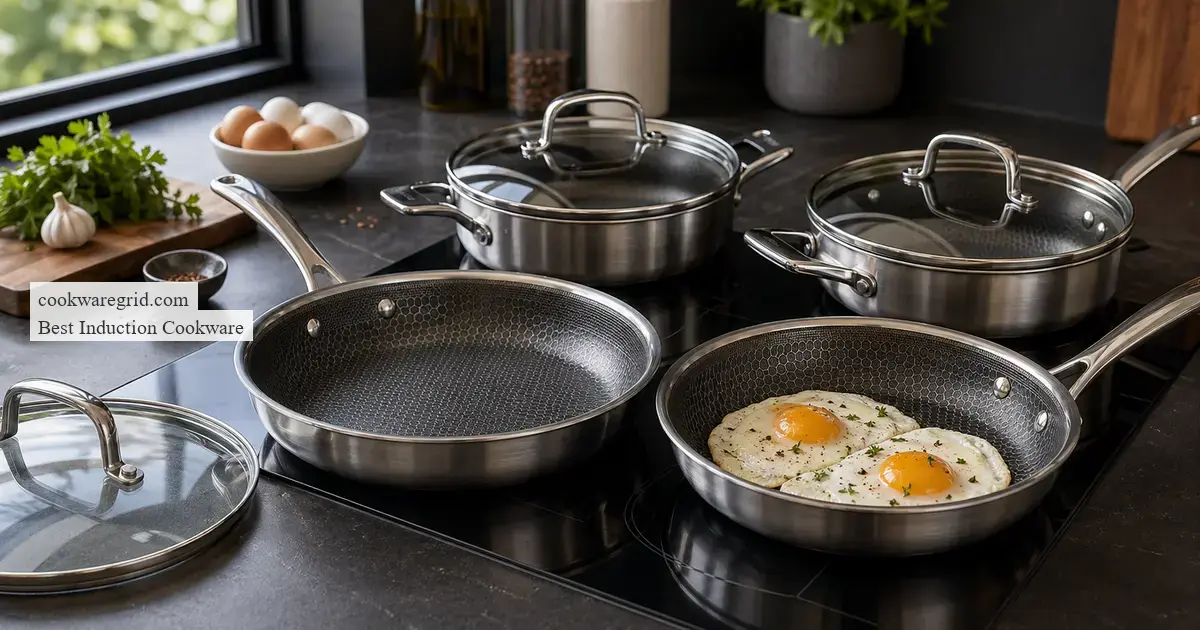
Best hybrid convenience
6. HexClad Hybrid Pots and Pans Set
HexClad is the outlier in this list because it is not traditional stainless and not traditional nonstick. The current Hybrid Pots and Pans Set page describes a tri-ply construction with an aluminum core, stainless steel hexagonal peaks, and TerraBond ceramic nonstick valleys. It also lists induction readiness, metal utensil safety, dishwasher safety, cookware oven safety up to 900°F, and tempered glass lids oven safe up to 400°F.
That hybrid design is aimed at cooks who want one pan to sear better than conventional nonstick while releasing food more easily than bare stainless. On induction, the aluminum core should help spread heat, while the magnetic layer activates the burner. The stainless peaks can create browning contact, while the coated valleys reduce sticking. HexClad currently positions the TerraBond ceramic valleys as PTFE-free, which makes the set relevant for shoppers comparing coated cookware options. It is a clever compromise, especially for households that dislike maintaining cast iron or carbon steel.
The caution is that hybrid cookware still has a coating component. Even when a brand claims better durability and high heat tolerance, nonstick-like surfaces should be treated with more care than plain stainless. Do not cut in the pan, avoid unnecessary empty high-power preheats, and confirm the latest coating and safety details before buying because product lines can change. HexClad is convenient, but it is not the same long-term category as uncoated clad stainless.
Buy HexClad if your priority is easy release with credible induction compatibility. Choose All-Clad, Demeyere, Misen, or Tramontina if your priority is a pan you can scrub, deglaze, sear, and use hard for decades without thinking about a coating.
- Easier release than bare stainless
- Tri-ply aluminum-core construction
- Induction ready with high cookware oven rating
- Coating requires more care than bare stainless
- Glass lids have lower heat limit
- Not the best choice for purists who want uncoated cookware
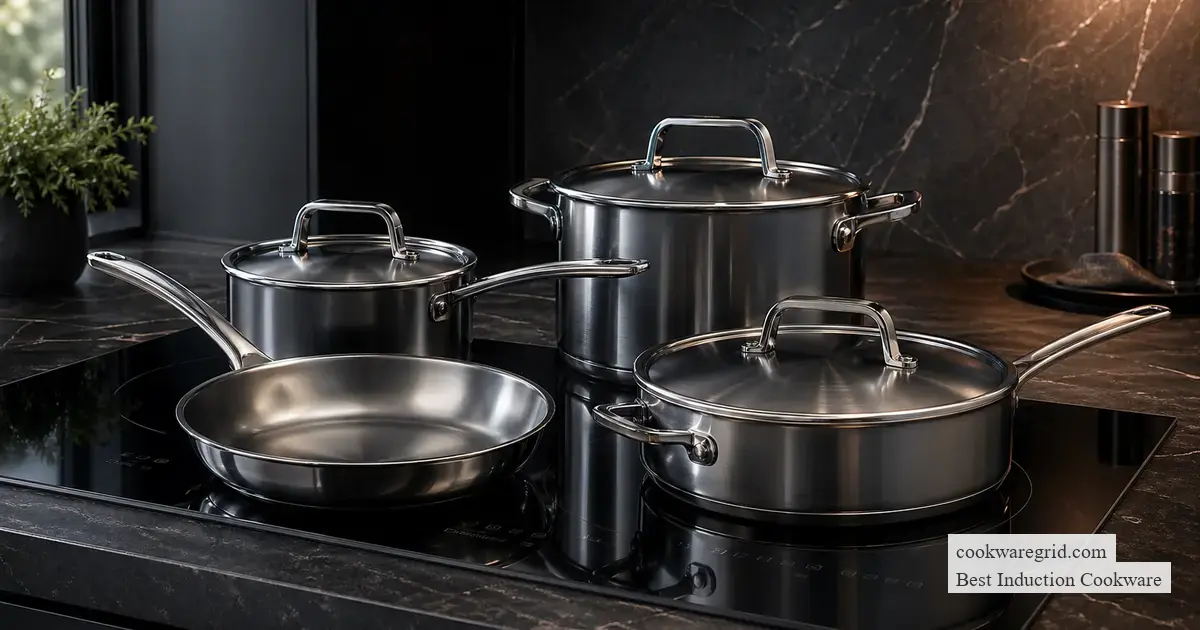
Best luxury high-heat set
7. Hestan NanoBond 10-Piece Titanium Ultimate Cookware Set
Hestan NanoBond is the luxury pick for cooks who want extreme engineering more than affordability. Hestan's product page describes a molecular titanium surface bonded to stainless steel, ProCore aluminum for greater heat conductivity, sealed rims, flush rivets, induction optimization, dishwasher safety, and oven, broiler, and grill safety up to 1050°F. It is made in Italy and positioned as a lifetime set.
The 1050°F rating is far beyond ordinary home oven use, but it is meaningful for cooks who broil aggressively, use outdoor grills, or want cookware that can survive abuse. The sealed rims are also important. Some clad cookware exposes aluminum at the edge; over years of dishwasher use, that exposed layer can erode. Sealed rims protect the cladding and make the cookware easier to trust in a dishwasher-heavy household.
On induction, Hestan's combination of induction optimization, aluminum core technology, and durable surface makes it a technical standout. The flush rivets are not just pretty; they remove a cleaning nuisance from the pan interior. The titanium surface is also designed to resist scratching, staining, and salt pitting better than typical stainless steel.
The reason it ranks below more mainstream sets is simple: price. Most cooks will get excellent induction meals from All-Clad, Demeyere, or Misen for less money. Hestan NanoBond is for buyers who want the premium finish, the very high heat ceiling, and the satisfaction of owning cookware that feels engineered beyond normal home requirements.
- Extreme 1050°F heat tolerance
- Sealed rims and flush rivets
- Scratch, stain, and salt-pitting resistance
- Very expensive
- Overbuilt for many home kitchens
- Premium benefits may not beat good 5-ply for everyday tasks
Buying guide
How to Choose the Best Induction Cookware
Start with the magnet test. Induction cookware must contain ferromagnetic material. If a magnet sticks firmly to the bottom of the pan, it should work on induction. If the magnet barely clings, the pan may heat weakly or fail to trigger the burner. For a deeper step-by-step process, read our detailed guide on how to tell if cookware is induction ready.
Understand stainless steel grades. Stainless steel is not automatically magnetic. Many cookware interiors use 18/10 stainless steel because it resists corrosion and provides a stable cooking surface. But 18/10 is often not strongly magnetic. Good induction stainless cookware solves this by using a magnetic stainless exterior, often 18/0, with aluminum or copper inside for heat distribution and 18/10 stainless on the cooking surface.
Choose the construction for the job. Tri-ply cookware usually means stainless steel around an aluminum core. It is responsive, versatile, and not too heavy. 5-ply cookware adds layers and often more mass, which can improve heat retention and stability. 7-ply or specialty bases can add even more control, but they also increase weight and price. Copper-core cookware can be very responsive, but the induction-facing exterior still needs magnetic material.
Do not ignore base flatness. A flat base is one of the most important induction features because the pan must sit close to the glass and magnetic field. Rocking pans heat unevenly and can be noisy. Warped pans can trigger error codes, pulsing, or dead zones. Demeyere's flat base stability language is notable because it addresses this issue directly. At home, place the pan on a flat counter and press lightly on the rim. If it rocks when cold, it is not ideal for induction.
Pick materials by cooking behavior. Clad stainless steel is the most versatile because it can sear, simmer, deglaze, and go in the oven. Cast iron is naturally induction compatible and excellent for heat retention, but it is heavy and slow to adjust. Carbon steel is lighter than cast iron, responsive, and excellent for high-heat searing once seasoned. Ceramic or hybrid nonstick is convenient for eggs and delicate foods, but it should not replace uncoated stainless for hard searing and long service life.
Watch oven and lid limits. A pan rated to 600°F or 800°F is useful only if the lid and handle can also tolerate the temperature you plan to use. HexClad, for example, lists high heat tolerance for the cookware but a lower limit for glass lids. Tramontina's glass-lid set is oven safe to 350°F, which may be enough for many cooks but is lower than All-Clad, Demeyere, Le Creuset, Misen, and Hestan.
Expect some induction sound. Humming, buzzing, and faint high-pitched sounds can be normal. GE and Samsung both describe cookware-related induction sounds as part of operation. Heavier cookware can be quieter than lightweight multi-ply stainless, and changing the power setting can reduce resonance. If this is your pain point, read our guide to why induction cookware buzzes.
Buy fewer, better pieces. A great induction kitchen does not need 17 pieces. A 10-inch clad stainless skillet, 3-quart saucepan, saute pan, stockpot, and one cast iron or carbon steel searing pan can cover most meals. A large set makes sense when the included pieces match your cooking, not when the piece count looks impressive.
FAQ
Best Induction Cookware FAQ
Short answers to the questions that decide whether a set will feel great on induction or merely function.
What cookware is best for induction?
Fully clad stainless steel cookware with a flat magnetic exterior and an aluminum or copper core is best for most induction kitchens. It combines reliable burner detection with responsive, even heating and does not require seasoning; cast iron and carbon steel are stronger choices when maximum searing heat matters more than weight or maintenance.
What is the best cookware for induction cooking?
All-Clad D3 is the best cookware for induction cooking for most home cooks because its tri-ply body balances heat response, durability, and manageable weight. Tramontina Tri-Ply offers similar fully clad fundamentals for less, while the heavier Demeyere Industry 5 suits cooks who favor heat retention and base stability.
What is the best induction cookware material?
Clad stainless steel is the best all-around induction cookware material because it pairs a durable cooking surface with a conductive aluminum or copper core and a magnetic exterior. Cast iron retains more heat, carbon steel is lighter and faster, and induction-ready nonstick is useful for delicate foods but has a shorter service life.
What is best for induction cooktops?
Cookware that strongly attracts a magnet, sits completely flat, and closely matches the burner diameter is best for induction cooktops. Those features help the cooktop recognize the pan, transfer power efficiently, and avoid concentrated hot rings; a thick conductive layer then spreads that energy toward the edge of the cooking surface.
Can compatible cookware perform poorly?
Yes, induction-compatible cookware can still perform poorly if its magnetic layer is weak, narrow, thin, or warped. A pan may activate the burner yet heat only over the coil, cycle at low power, rock on the glass, or lose detection when hot, which is why the induction symbol alone does not guarantee good cooking performance.
Why does cookware buzz on induction?
Cookware buzzes on induction because the cooktop's changing magnetic field can make bonded metal layers, lids, handles, or a slightly uneven base vibrate. Some humming is normal, especially at high power, but matching the pan to the burner, lowering the setting, and using flatter, heavier cookware can often reduce it; learn more in our guide to induction cookware buzzing.
Specification Sources
CookwareGrid used current manufacturer and retailer specification pages for construction, material, induction, and oven-safe claims. Always confirm final product details on the seller page before purchase because sets, lids, coatings, and included pieces can change.
- All-Clad D3 Stainless 10-Piece Cookware Set
- Demeyere Industry 5 10-Piece Pots and Pans Set
- Tramontina Tri-Ply Clad Stainless Steel Cookware Set with Glass Lids
- HexClad Hybrid Pots and Pans Set
- Le Creuset Essential Stainless Steel 10-Piece Cookware Set
- Misen Stainless Steel Cookware Set
- Hestan NanoBond 10-Piece Titanium Ultimate Cookware Set
- GE Appliances Induction Cooking Education
- Samsung Cooktop Cookware Requirements
- GE Appliances Induction Cooktop Humming Sound
About Leamon Warner
Leamon Warner is a kitchen expert, researcher, and founder of CookwareGrid with more than 25 years of experience in the kitchen and home-goods industry. His background includes work with LG, Lamacom Group, and Fleur Metal, alongside cookware research, product testing, and conversations with industry experts. He created CookwareGrid to turn that experience into clear, practical advice for home cooks.