Troubleshooting guide
Why Does Induction Cookware Buzz?
Induction cookware buzzes because magnetic energy can make metal vibrate. The sound is usually normal, but the volume depends on cookware thickness, base flatness, pan layers, thermal conductivity, burner size, food load, and power setting.

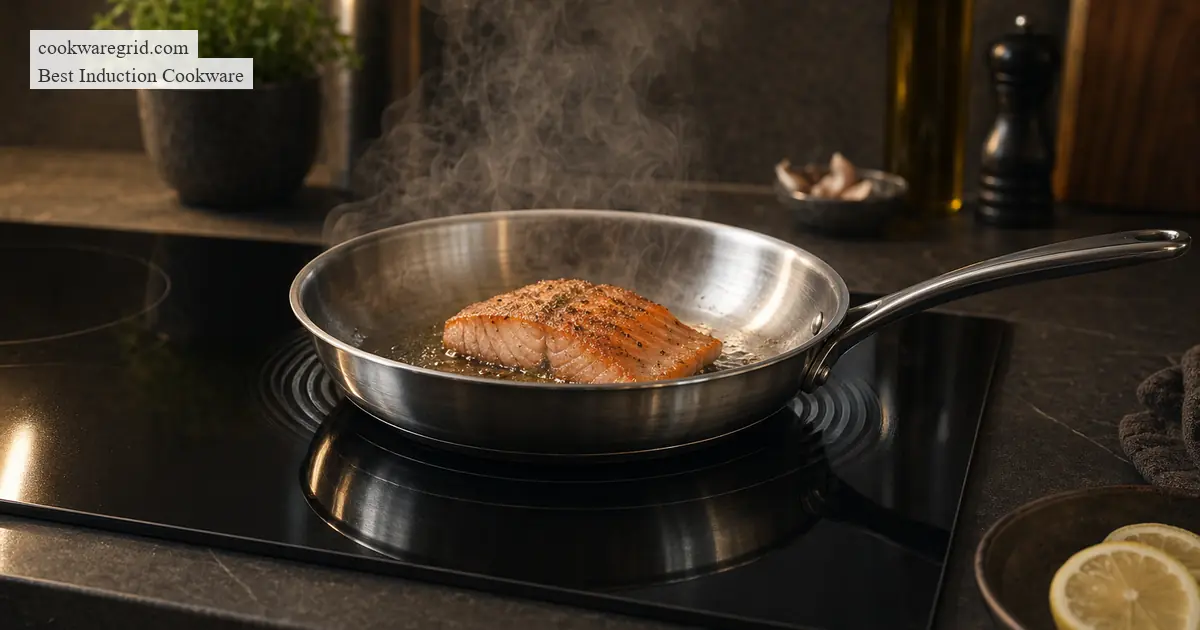
A light buzz, hum, click, or whistle from an induction cooktop is often normal. The sound usually comes from magnetic energy interacting with cookware, cooling fans, electronic switching, or vibration in layered metal pans. The fix is usually cookware-related, not a repair call.
Induction is quiet in one way and noisy in another. It avoids the roar of a gas flame and the ticking expansion sounds of old electric coils, but it adds its own soundtrack because the pan is part of the electromagnetic system. GE Appliances notes that slight humming or buzzing may be produced by different cookware types and that heavier pans such as enameled cast iron can produce less noise than lighter multi-ply stainless steel. Samsung similarly describes buzzing as normal on induction ranges, depending on cookware material.
That does not mean every sound should be ignored. A gentle hum at high power is different from a loud rattle caused by a warped pan or a shriek that appears only with one damaged vessel. The useful question is not "Should induction be silent?" It is "Is this sound normal for this pan, on this burner, at this setting?"
If you are shopping because your current pans are loud, start with our guide to the best induction cookware. Better cookware cannot make induction perfectly silent, but thicker, flatter, well-matched pans usually sound calmer and cook more evenly.
Diagnosis
What Causes Induction Cookware Buzzing and Magnetic Vibration?
Induction noise can come from the pan, the appliance, or the interaction between several pans running at once.
Magnetic Vibration
The cooktop creates a rapidly changing magnetic field. Ferromagnetic metal in the pan can vibrate slightly as energy transfers into heat.
Thin Cookware
Lightweight pans have less mass to damp vibration. Thin bonded bases can sound sharper than heavy cast iron or thick 5-ply stainless.
Layered Metal
Multi-ply cookware contains different metals bonded together. Those layers can resonate, especially at high power or with empty pans.
Warped or Rocking Base
If the base is not flat, it can vibrate against the glass or sit unevenly in the magnetic field, increasing noise and hot spots.
Power Setting
Buzzing often grows louder at boost or high settings. GE notes that power settings can affect humming and that changing settings may reduce noise.
Cooling Fan
Some noise is not the cookware at all. Induction electronics use fans that can hum or whir during and after cooking.
Cookware construction
Why Pan Layers, Ferromagnetic Cores, and Thermal Conductivity Change the Sound
Most good induction cookware is layered. A clad stainless pan might have a magnetic stainless exterior, aluminum core, and stainless cooking surface. A 5-ply pan may add more aluminum alloy or stainless layers. Hybrid cookware can add a textured stainless network and coated valleys. These designs are good for cooking because they combine magnetism, corrosion resistance, and heat distribution. But different metals expand, contract, and vibrate differently.
That is why two induction-compatible pans can sound different on the same burner. A thin magnetic disc bonded to an aluminum nonstick body may buzz in a sharp tone. A fully clad tri-ply skillet may hum more softly but still become louder at high power. A thick 5-ply stainless pan may sound steadier because the additional mass damps vibration. Enameled cast iron may be quieter still because it is heavy and monolithic, though it heats and cools more slowly.
Layering is not bad. In fact, it is usually what makes induction cookware good. Bare magnetic steel can activate a burner, but it does not spread heat as evenly as aluminum-core clad stainless. The same rule applies to PTFE-free ceramic or hybrid nonstick cookware: the coating may define food release, but the magnetic base defines induction behavior. The goal is not to avoid layers. The goal is to buy cookware with layers that are well bonded, thick enough to stay stable, flat enough to maintain good contact, and conductive enough for even heat distribution.
Demeyere Industry 5 is a useful example because its manufacturer emphasizes 5-ply construction, thick aluminum core, and flat base stability. Misen is another because it publishes a 5-ply structure with induction-compatible 18/0 stainless outside and 18/10 stainless inside. These details matter because buzzing is often reduced by better physical stability, not by weaker induction power.
Contact
Why Base Flatness and Warp Resistance Reduce Induction Noise
Base flatness affects both cooking and sound. Induction works through the glass surface, so the cookware base should sit close and stable over the burner. If a pan rocks, bows, or has a damaged base, it may vibrate more audibly. It may also heat unevenly because parts of the base are not interacting with the magnetic field in the same way.
Flatness problems show up in several ways. A skillet may spin or wobble when you stir. Oil may pool toward the edge instead of forming an even film. Food may brown in a ring over the coil but stay pale outside it. The cooktop may click or cycle because detection is inconsistent. The pan may buzz loudly when empty, then quiet slightly when food weight presses the base down.
To check a pan, let it cool completely and place it on a known-flat counter. Press on opposite sides of the rim. If it rocks, it is not ideal. Then place a straightedge across the base. If you see obvious daylight, the pan is warped. Some cookware is manufactured with a tiny concave shape to account for heat expansion, but visible rocking on glass is a practical warning sign.
Preventing warping is also part of noise control. Avoid long empty preheats on boost, do not plunge hot pans under cold water, and avoid using a burner much larger than the pan base. Stainless cookware makers often warn against thermal shock because rapid temperature changes can distort metal. A pan that stays flat will usually cook better and sound better.
Practical fixes
How to Reduce Induction Buzzing with Better Cookware Fit
Use these adjustments before assuming the cooktop is defective.
| Symptom | Likely Cause | Fix |
|---|---|---|
| Loud buzz on boost | High magnetic power vibrating the pan | Lower from boost to high or medium-high once the pan is hot |
| Sharp whine from one pan | Thin base, loose bonded disc, or layered resonance | Try a heavier pan or thicker clad stainless |
| Rattle when stirring | Warped or rocking base | Replace the pan or use a flatter vessel |
| Noise changes with two burners on | Interaction between zones and cookware | Adjust one burner slightly higher or lower |
| Hum continues after cooking | Cooling fan | Let the cooktop cool; fan noise after shutoff can be normal |
| Cooktop clicks and pan heats slowly | Weak magnetism or base too small | Use induction-ready cookware with a larger magnetic base |
Also consider the food load. An empty pan can buzz more because there is less mass damping vibration. Adding oil, water, or food sometimes changes the frequency and volume. That does not mean you should add food before the pan is ready for searing, but it does mean a brief empty noise during preheat is not always how the pan will sound during cooking.
Burner matching matters too. A small pan on a large zone can behave differently from the same pan on a smaller zone. A huge stockpot with a small magnetic center disc can also heat inefficiently because only the center interacts strongly with the burner. For both performance and sound, match the magnetic base diameter to the cooking zone as closely as practical.
Safety and service
When Induction Noise May Be a Problem
Normal induction sounds are usually steady and tied to burner power. They change when you change cookware, add food, move burners, or adjust the setting. A problem sound is more likely when it is new, very loud, accompanied by error codes, associated with burning smells, or present without cookware.
If one pan is loud and all others are normal, the pan is the suspect. If all pans are suddenly loud on one zone, the cooktop may need service. If a cooling fan grinds, rattles, or runs abnormally long after normal cooling, check the manual or contact the manufacturer. Do not keep using cookware with a loose base plate, separated layers, or a badly warped bottom.
For most cooks, the better solution is cookware selection. Choose thicker clad stainless, cast iron, carbon steel, or a high-quality set with flat-base stability. Avoid ultra-thin pans that barely pass the magnet test. If you are replacing cookware, compare real construction specs rather than relying on the word "induction" alone.
FAQ
Induction Cookware Buzzing FAQ
Is induction cookware buzzing normal?
Yes. Some buzzing, humming, or faint whistling can be normal because induction transfers energy magnetically and can make cookware vibrate. The sound often changes with pan material and power level.
Which cookware is quietest on induction?
Thicker, flatter cookware often sounds quieter. Heavy cast iron, enameled cast iron, and stable 5-ply stainless steel can reduce vibration compared with thin pans or weak bonded bases.
How do I reduce induction buzzing?
Use a flatter, heavier pan, match the base to the burner size, lower or slightly adjust the power level, add food or liquid before prolonged high power, and avoid warped cookware.
Does buzzing mean my cookware is bad?
Not necessarily. Even good cookware can hum on induction. But loud rattling, weak heating, or buzzing from only one warped pan can mean the cookware is a poor match.
About Leamon Warner
Leamon Warner is a kitchen expert, researcher, and founder of CookwareGrid with more than 25 years of experience in the kitchen and home-goods industry. His background includes work with LG, Lamacom Group, and Fleur Metal, alongside cookware research, product testing, and conversations with industry experts. He created CookwareGrid to turn that experience into clear, practical advice for home cooks.