Kitchen guide
How to Tell If Cookware Is Induction Ready
The fastest way to check induction cookware is the magnet test, but a magnet is only the first screen. The best results come from a ferromagnetic core or base that is also flat, wide enough for the burner, and built with enough conductive metal for even heat distribution.

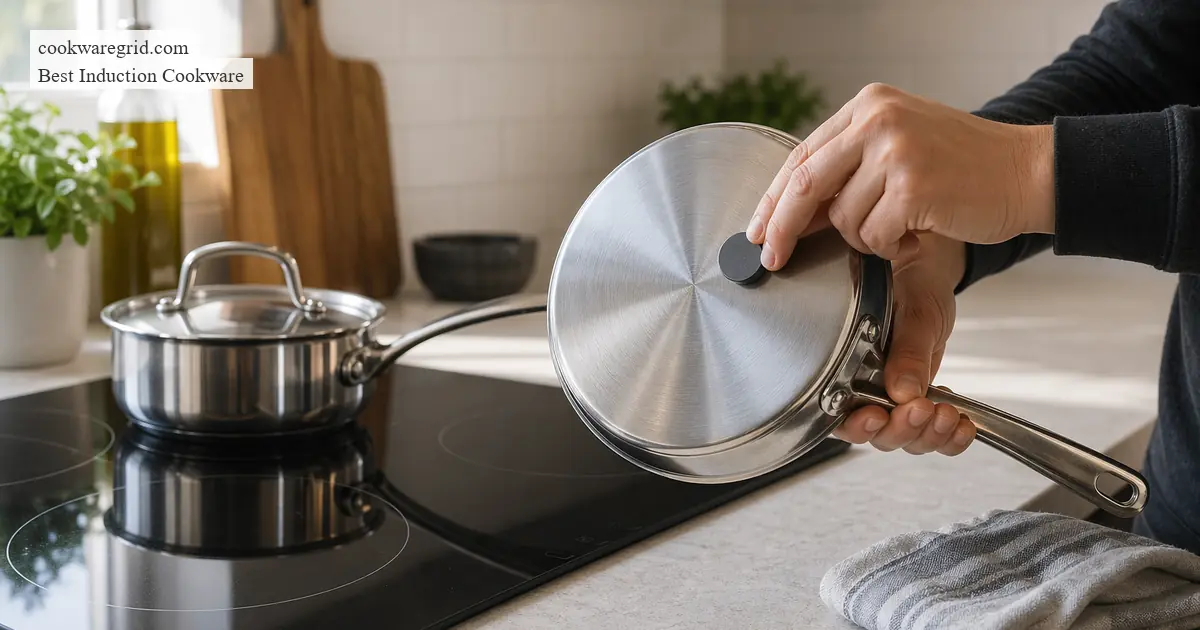
If a magnet sticks firmly to the bottom of a pan, the pan is likely induction ready. If the magnet does not stick, the pan will not heat on an induction cooktop unless it is used with an adapter disc, which usually reduces the speed and precision that make induction worth owning.
Induction cooking is different from gas or radiant electric because the cooktop does not simply throw heat at the pan. It creates a magnetic field below the glass. When compatible cookware sits over that field, ferromagnetic metal in the pan interacts with the field and generates heat in the cookware itself. That is why induction can boil quickly, respond fast, and keep much of the surrounding glass cooler than a conventional electric surface.
The catch is that cookware has to be part of the cooking system. GE Appliances explains that induction cookware needs iron content and that a magnet sticking to the bottom is the simple home test. Samsung's cookware guidance makes the same practical point: induction cookware needs a magnetic base, and the magnetic portion should match the element size. Those two details, magnet strength and base size, explain most compatibility problems.
If you are building a new kitchen around induction, start with our main guide to the top rated induction cookware. If you are checking pans you already own, follow the test sequence below before you donate, replace, or buy anything.
Step one
How to Do the Induction Magnet Test for a Ferromagnetic Core
- Turn the pan upside down and clean the base so the magnet touches metal, not grease or residue.
- Use a normal refrigerator magnet or a stronger utility magnet.
- Place the magnet against the center of the bottom cooking base.
- Lift your hand slightly. A good induction base should hold the magnet firmly.
- Move the magnet around the base, especially toward the outer cooking area.
A strong stick usually means the pan contains enough ferromagnetic metal to activate an induction burner. A weak stick can be a warning sign. The pan may work, but it may heat slowly, pulse at lower settings, or fail on smaller burners. No stick means the pan is not induction compatible by itself, no matter how attractive the cookware finish looks.
The magnet test is especially useful for older stainless steel, enameled cookware, and nonstick aluminum pans, including newer PTFE-free ceramic pieces that still need a magnetic base to work on induction. New cookware often carries an induction symbol, but older pans may not. Some cookware also has a magnetic disc bonded to the bottom, so the sidewalls may not be magnetic even though the base works on induction.
Do not test only the upper rim or side of the pan. Induction compatibility is about the cooking base. A pan with a magnetic handle or rim but a nonmagnetic base will not perform correctly.
Materials
Which Cookware Materials Are Induction Ready for Even Heat Distribution?
The material name on the box can help, but the bottom layer matters more than the marketing category.
| Material | Induction Ready? | What to Check | Best Use |
|---|---|---|---|
| Cast iron | Usually yes | Flatness, weight, enamel condition | Searing, baking, heat retention |
| Carbon steel | Usually yes | Seasoning, flat base, pan diameter | High-heat sauteing, eggs after seasoning, searing |
| Clad stainless steel | Often yes | Magnetic exterior or base layer | Everyday cooking, sauces, searing, deglazing |
| Aluminum | No, unless modified | Bonded magnetic stainless base | Nonstick skillets, lightweight saucepans |
| Copper | No, unless modified | Magnetic stainless exterior or induction plate | Precise sauces when made induction-compatible |
| Glass or ceramic | No | Generally not compatible for induction burners | Oven baking, storage, serving |
Stainless steel details
Why Some Stainless Steel Works on Induction and Some Does Not
Many shoppers assume stainless steel automatically means induction ready. That is not true. Stainless steel comes in different grades and magnetic behaviors. The corrosion-resistant 18/10 stainless steel used on many cooking surfaces is excellent for food contact, but it may not be magnetic enough to activate an induction cooktop on its own.
High-quality induction stainless cookware often uses a layered solution. The inner cooking surface can be 18/10 stainless steel for corrosion resistance, while the exterior layer is magnetic stainless steel, often 18/0. Between those stainless layers, aluminum or copper spreads heat. Misen describes this kind of architecture clearly: an induction-compatible 18/0 stainless layer, aluminum and aluminum alloy layers, and an 18/10 stainless cooking surface.
Fully clad stainless cookware usually spreads heat better than a cheap pan with only a magnetic disc on the bottom because aluminum or copper layers improve thermal conductivity. A disc base can work well for boiling water in a stockpot because heat is needed mostly at the base. But for skillets and saute pans, full cladding helps move heat into the sidewalls and out toward the edges. That is why sets like All-Clad D3, Demeyere Industry 5, Tramontina Tri-Ply, and Le Creuset stainless appear often in induction cookware recommendations.
One more nuance: stronger magnetism does not automatically mean better cooking. Cast iron is extremely induction compatible but slower to respond than clad stainless. Aluminum is not magnetic but spreads heat beautifully when placed inside a magnetic stainless shell. The best induction cookware combines magnetic response with conductive heat distribution.
Fit and flatness
Why Base Size, Flatness, and Warp Resistance Matter After the Magnet Test
A pan can pass the magnet test and still perform badly if the base is too small, too warped, or poorly matched to the burner. Samsung notes that the magnetic portion of the base should match the size of the element used. That is practical advice: induction burners are designed around a detection zone. A tiny magnetic disc under a wide pan may activate the cooktop, but the outer pan can remain cooler than expected.
Flatness matters just as much. The best induction contact happens when the cookware base sits close to the glass across the burner area. A warped pan creates air gaps and unstable contact. It may rock, buzz, heat unevenly, or trigger pan detection issues. Thin cookware can also distort when heated too aggressively, especially if it is empty.
To check flatness, place the pan on a stone counter or another known-flat surface. Press gently on opposite rim edges. If the pan rocks, it is not ideal. Then hold a straightedge across the bottom and look for daylight. A very slight manufacturing curve may exist in some cookware, but obvious rocking is a problem for induction.
When buying new cookware, do not rely only on the top diameter. The cooking base diameter is often smaller than the rim diameter, especially in sloped skillets and woks. For induction, the base is what the burner sees.
Avoid these
Common Induction Compatibility Mistakes
Most problems are easy to avoid if you separate magnetic compatibility from overall cooking performance.
Testing the Wrong Spot
Always test the bottom cooking base. A magnetic rim, side, or handle does not prove the pan will work on induction.
Ignoring Weak Magnet Pull
A weak magnetic response may technically work but can be slow, noisy, or inconsistent. Stronger base contact is better.
Buying by Piece Count
A large set is not useful if several pieces have tiny bases that do not match your induction zones.
Using Warped Cookware
Warping reduces contact and can cause rocking, buzzing, and uneven heating. Flat cookware is more important on induction than on gas.
Assuming Aluminum Fails Forever
Bare aluminum fails, but aluminum cookware with a bonded magnetic stainless base can work on induction.
Expecting Silence
Some humming is normal on induction. If sound is your biggest concern, use thicker, flatter cookware and match burner size carefully.
FAQ
Induction-Ready Cookware FAQ
How do I know if my cookware is induction ready?
Hold a magnet against the bottom of the pan. If it sticks firmly and the base is flat and close to your burner size, the pan is likely induction ready.
Does all stainless steel work on induction?
No. Stainless steel must include enough magnetic material, often in the exterior layer or bonded base, to work on induction. Many quality pans use magnetic stainless outside and 18/10 stainless inside.
Can aluminum cookware work on induction?
Bare aluminum will not work because it is not ferromagnetic. Aluminum cookware can work if it has a bonded magnetic stainless steel base or magnetic exterior layer.
Is cast iron induction ready?
Yes, cast iron is usually induction ready and holds heat extremely well. Use it carefully because it is heavy and can scratch glass if dragged.
About Leamon Warner
Leamon Warner is a kitchen expert, researcher, and founder of CookwareGrid with more than 25 years of experience in the kitchen and home-goods industry. His background includes work with LG, Lamacom Group, and Fleur Metal, alongside cookware research, product testing, and conversations with industry experts. He created CookwareGrid to turn that experience into clear, practical advice for home cooks.