Cooktop Compatibility
Can You Use Induction Cookware on Gas or Electric Stoves?
Most induction cookware can also be used on gas, radiant electric, and coil electric stoves. Induction compatibility adds a magnetic requirement; it does not normally remove compatibility with conventional heat sources.

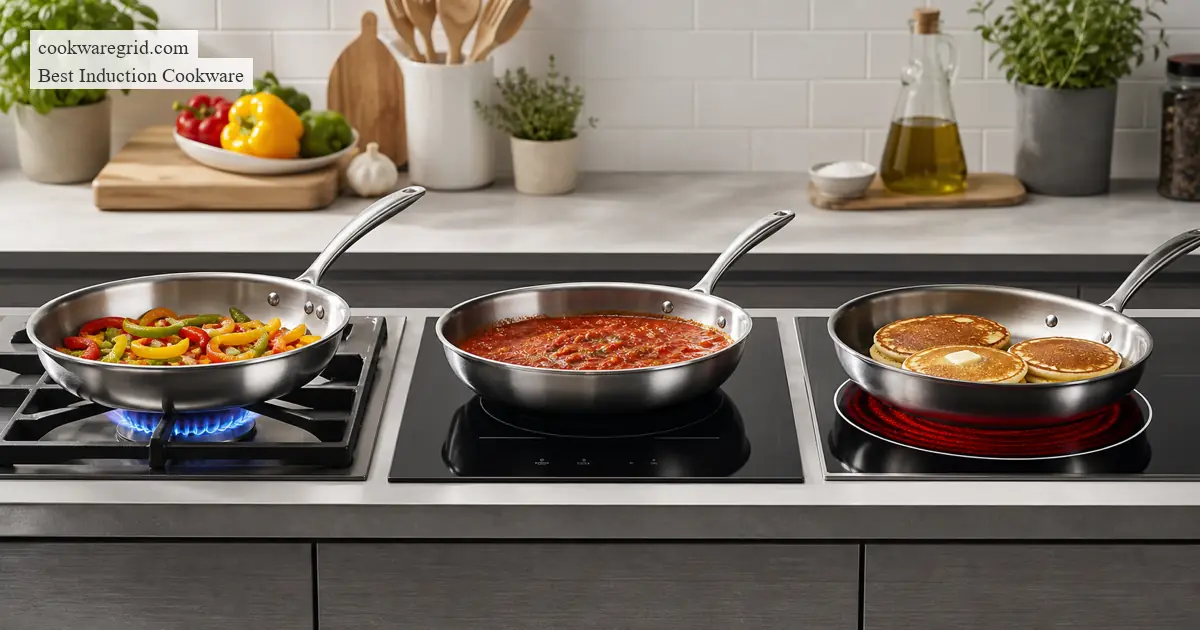
Short answer: yes, with a few exceptions. Check the manufacturer’s cooktop list, protect coated exteriors from flame, and keep the base flat and clean for glass-top electric cooking.
A pan labeled “induction compatible” is not powered by special electronics. It is ordinary cookware built with enough ferromagnetic material for an induction field to heat it. Gas flames and electric elements can still transfer heat into that same pan by convection, radiation, and direct contact.
The practical question is therefore not whether the pan can become hot, but whether its handles, coatings, base, and dimensions suit the new heat source. Our induction cookware vs regular cookware guide explains the construction difference in more detail.
Compatibility
Why Induction Cookware Usually Works on Every Major Cooktop
Induction cookware is commonly made from cast iron, carbon steel, enameled iron, magnetic stainless steel, or aluminum with a magnetic steel plate. All of these materials can absorb heat from a gas flame or electric element. The magnetic feature matters only when the induction coil is the energy source.
Fully clad stainless cookware is especially versatile. A magnetic stainless exterior makes it induction ready, while the aluminum or copper core spreads heat on gas and electric. Many manufacturers explicitly rate the same collection for induction, gas, electric, ceramic, and halogen cooktops.
Compatibility does not guarantee identical performance. Gas heats the base and sidewalls with moving flame, radiant electric heats where the pan touches the glass, and induction generates heat mainly inside the magnetic footprint. Expect to adjust burner size, preheat time, and power even when the pan itself stays the same.
Open flame
Using Induction Cookware on a Gas Stove
Center the pan over a burner that matches the base and keep the flame beneath the bottom rather than curling up the sidewalls. Oversized flame wastes energy, heats handles, discolors stainless exteriors, and can damage paint, silicone, or nonstick coatings that extend down the sides.
Disc-bottom cookware may behave differently on gas because the flame can heat the thinner sidewall above the disc. Fully clad cookware generally handles that transition more evenly. Cast iron and carbon steel are naturally comfortable over flame, but lift rather than drag them across nearby surfaces.
Gas can leave soot when combustion or burner adjustment is poor. That residue should be removed before placing the pan on a glass induction or radiant surface, where grit can scratch. See induction vs gas cookware for a deeper comparison of pan shape and heat response.
- Match the flame to the bottom diameter.
- Keep flame away from handles and coated sidewalls.
- Clean soot before returning to a glass cooktop.
- Expect slower response than induction at the same visual setting.
Contact heat
Using Induction Cookware on Radiant or Coil Electric
Radiant glass and solid electric elements reward flat cookware. A pan that rocks or bows leaves air gaps, slows heat transfer, and can cycle unevenly. Induction can sometimes heat a slightly uneven magnetic base, but conventional electric contact makes the flatness penalty more obvious.
Heavy induction bases take longer to preheat on radiant electric because the element must first heat itself and the glass. Start a little earlier, but avoid compensating with maximum power and an empty pan. Once the base is hot, its thermal mass can overshoot the target.
On coil electric, make sure the cookware is stable and not dramatically larger than the element. Smooth-bottom pans are easiest to use on glass. Keep both surfaces free of salt, sugar, and grit, and read induction vs electric cookware for material-specific recommendations.
Check first
Exceptions That Can Limit Cross-Cooktop Use
Some cookware has removable handles, temperature-sensitive exterior finishes, low oven limits, or bases intended only for smooth surfaces. Portable induction accessories can also have geometry that is unstable on gas grates. The manufacturer’s instructions take priority over a general material rule.
Glass lids deserve separate attention: a pan may tolerate high heat while its lid has a much lower oven or broiler limit. Nonstick cookware can work on all three cooktops and still be damaged by empty high-heat preheating. Enameled cast iron works broadly, but rough or dirty bases need careful handling on glass.
Also avoid assuming that an induction adapter plate makes any vessel universally safe. The plate may become hotter than the cookware above it, and some cooktop makers prohibit adapters because they can trap heat near the glass and electronics.
Practical setup
How to Move the Same Cookware Between Cooktops
Before switching, inspect the base for carbon, grease, metal burrs, and warping. Clean it, dry it, and confirm that the pan sits securely. Use moderate heat for the first few sessions while you learn the new control scale. A “6” on induction is not equivalent to a medium gas flame or a radiant setting of “6.”
If you move cookware regularly between gas and glass, reserve rough-bottom cast iron for careful lift-and-place use and keep stainless or smooth enameled pieces for everyday transitions. The best cross-platform collection is flat, dimensionally stable, easy to clean underneath, and explicitly approved for each cooktop you own.
FAQ
Can You Use Induction Cookware on Gas or Electric? FAQ
Direct answers to the practical questions readers ask most often.
Can induction cookware be used on a gas stove?
Yes, most induction-compatible stainless steel, cast iron, carbon steel, and magnetic-base cookware works on gas. Keep flames beneath the base and check exterior and handle limits.
Can induction cookware be used on a regular electric stove?
Yes. Radiant and coil electric elements can heat induction cookware, but the base should be flat for stable contact and even results.
Will gas damage an induction base?
Normal correctly sized flames should not damage a well-made base. Oversized flames, soot, thermal shock, and overheating can discolor or distort cookware over time.
Does using induction cookware on gas make it stop working on induction?
No. Ordinary gas use does not remove magnetism. Severe warping or residue on the base can, however, reduce stability and performance when the pan returns to induction.
Editorial references
Sources and Further Reading
- All-Clad: D3 cooktop compatibility and care
- Tefal: induction, gas, electric, ceramic, and halogen compatibility
CookwareGrid uses manufacturer documentation and primary public guidance to verify technical and safety claims. Product instructions for your exact cookware and cooktop take priority over general advice.
About Leamon Warner
Leamon Warner is a kitchen expert, researcher, and founder of CookwareGrid with more than 25 years of experience in the kitchen and home-goods industry. His background includes work with LG, Lamacom Group, and Fleur Metal, alongside cookware research, product testing, and conversations with industry experts. He created CookwareGrid to turn that experience into clear, practical advice for home cooks.