Care & Troubleshooting
How to Season Cast Iron on Induction Without Overheating the Center
For routine maintenance, warm the clean dry skillet gently, wipe on a microscopic oil layer, and stop before heavy smoking. Use an oven for a full uniform reseason when possible.

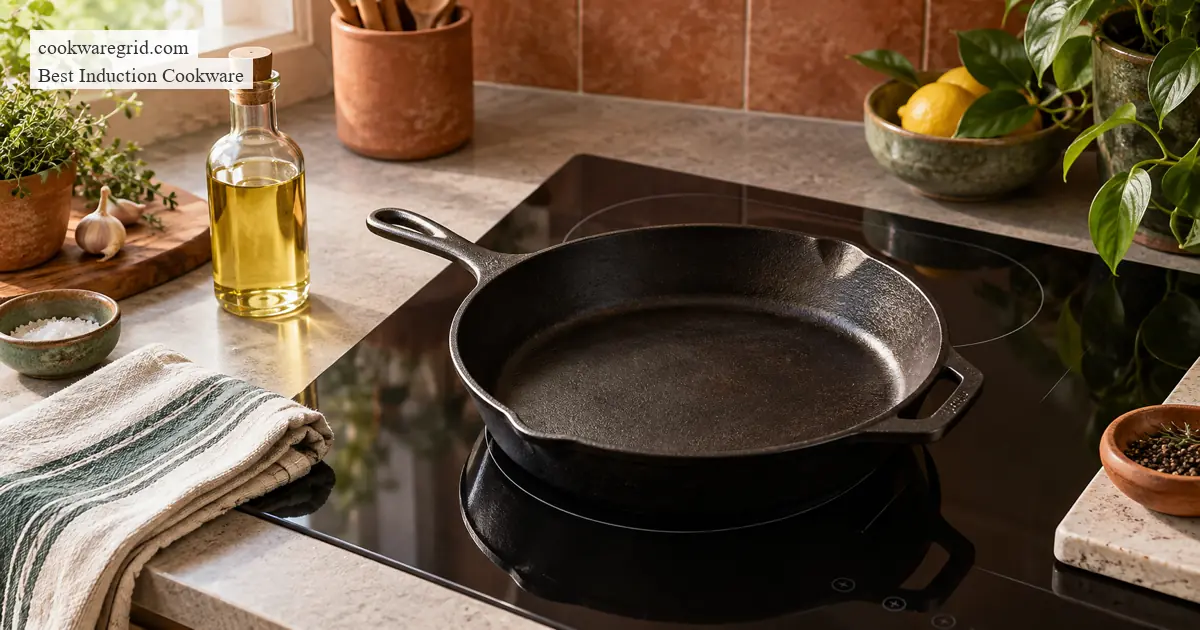
Quick answer: For routine maintenance, warm the clean dry skillet gently, wipe on a microscopic oil layer, and stop before heavy smoking. Use an oven for a full uniform reseason when possible.
Induction can change cookware temperature very quickly, so controlled heat and thin, even surface treatments matter. The steps below prioritize repeatable results while limiting thermal shock, localized overheating, and unnecessary wear.
For a broader comparison of complete sets and materials, start with our top rated induction cookware guide. Then use the measurements and checks below to match the vessel to your cooktop and cooking style.
Care & Troubleshooting
Slow preheat: What It Changes on Induction
Cold heavy iron over a powerful coil can develop sharp thermal gradients.
Induction generates heat in the magnetic portion of the cookware rather than heating the glass first. That makes slow preheat directly relevant to how quickly the vessel is detected, where energy enters the base, and how well that energy reaches food beyond the coil. Consider it alongside oil film; one strong specification cannot cancel out a poor physical match.
How to check it
Wash and dry promptly. Record what changes when you use a better-matched zone or a lower preheat setting; a repeatable improvement is more useful than a one-time visual impression.
Care & Troubleshooting
Oil film: What It Changes on Induction
Excess oil pools and cures into sticky patches instead of a hard layer.
Look at the usable cooking surface and the underside of the vessel, not only the diameter or material printed on the box. Oil film becomes meaningful when the pan is centered over a suitable zone and carries a realistic food load. A cold-pan inspection followed by moderate-power cooking reveals more than an aggressive empty-pan test.
How to check it
Warm gradually with a small amount of oil. Record what changes when you use a better-matched zone or a lower preheat setting; a repeatable improvement is more useful than a one-time visual impression.
Care & Troubleshooting
Existing seasoning: What It Changes on Induction
Most factory-seasoned pans need cooking and maintenance, not repeated full stripping.
In everyday cooking, existing seasoning shows up through control and consistency: how readily the pan responds when power changes, whether the perimeter keeps pace with the center, and whether the vessel remains stable on glass. Compare those observations with glass care before deciding that the cooktop itself is responsible.
How to check it
Wipe away every visible streak. Record what changes when you use a better-matched zone or a lower preheat setting; a repeatable improvement is more useful than a one-time visual impression.
Care & Troubleshooting
Glass care: What It Changes on Induction
Set the heavy skillet down gently and keep both surfaces free of grit.
Treat glass care as part of a heat-management routine. Begin below maximum power, allow the base time to equalize, and watch the food rather than relying only on the numbered setting. This is especially important when a broad pan sits over a smaller coil or when little food is available to absorb concentrated energy.
How to check it
Let the pan cool naturally before storage. Record what changes when you use a better-matched zone or a lower preheat setting; a repeatable improvement is more useful than a one-time visual impression.
Decision checklist
How to Apply This Guide in Your Kitchen
- Wash and dry promptly.
- Warm gradually with a small amount of oil.
- Wipe away every visible streak.
- Let the pan cool naturally before storage.
Test cookware cold and clean, then use moderate power with food or liquid present. Avoid prolonged empty boost heating and sudden cold-water cooling, two habits that amplify warping and coating damage.
FAQ
How to Season Cast Iron on Induction Without Overheating the Center FAQ
Does cast iron need seasoning before induction use?
Factory-seasoned cast iron is ready to cook, though regular drying and light oiling maintain it.
Can high induction power crack cast iron?
Severe uneven thermal stress can damage iron; Lodge recommends slow preheating.
Why is seasoning sticky?
The oil layer was probably too thick or insufficiently heated.
Sources and Further Reading
CookwareGrid uses manufacturer guidance, appliance documentation, and authoritative food-safety resources where applicable. Product specifications can change.
About Leamon Warner
Leamon Warner is a kitchen expert, researcher, and founder of CookwareGrid with more than 25 years of experience in the kitchen and home-goods industry. His background includes cookware research, product testing, and work with LG, Lamacom Group, and Fleur Metal.