Cooktop Comparisons
Induction vs Gas vs Electric Running Costs: Which Is Cheapest?
Induction usually uses delivered energy most efficiently, but the cheapest cooktop to run depends on local electricity and gas prices. Compare the cost of useful heat, not just the price of a kilowatt-hour or therm.

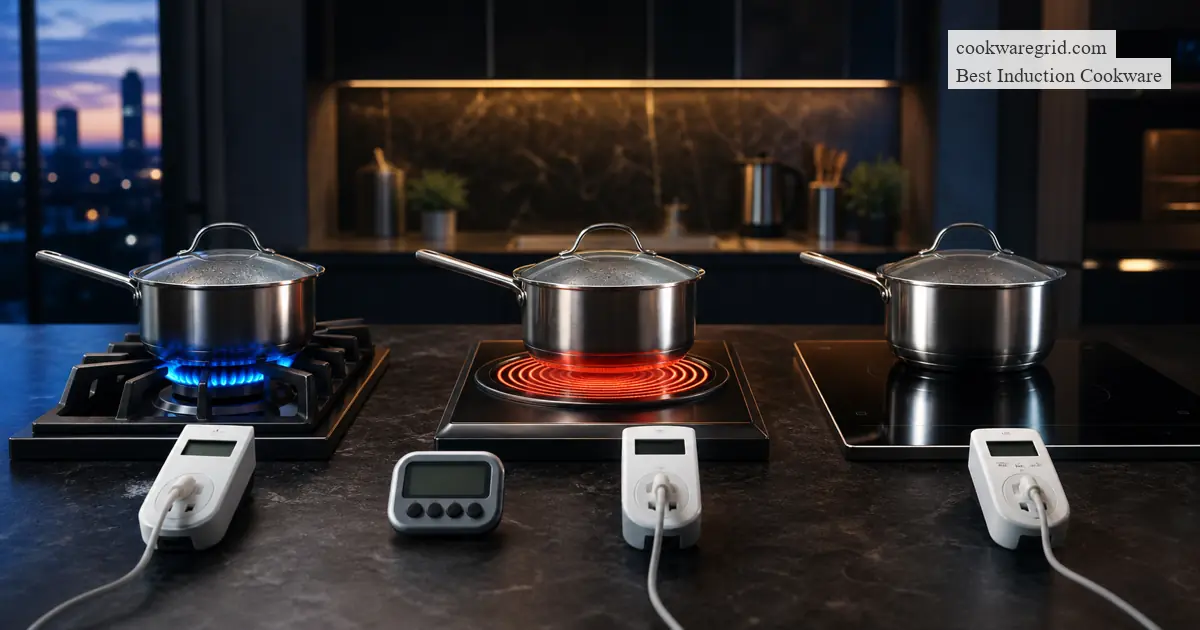
Efficiency answer: ENERGY STAR cites roughly 85% energy transfer for induction, 75–80% for conventional electric resistance, and about 32% for gas. Cost answer: multiply your rate by input energy, then account for those efficiency differences.
A gas rate and an electricity rate use different units, so they cannot be compared directly. One therm contains about 29.3 kilowatt-hours of energy, but only part of that input reaches the cookware. Induction sends a larger share into the pan, while gas releases much more heat into the room.
Rates change by location, plan, season, and time of day. This guide therefore gives a reusable method rather than pretending one national answer fits every household. It complements our cookware-focused comparisons of induction vs gas and induction vs electric.
Two variables
Energy Efficiency Is Not the Same as the Lowest Bill
Efficiency measures how much input energy reaches the cookware. ENERGY STAR’s induction guidance cites approximately 85% for induction, 75–80% for conventional electric resistance, and about 32% for gas cooking tops. The figures vary by test method and appliance, but they explain why induction boils quickly and adds less waste heat to the kitchen.
Price measures what your utility charges for each input unit. Cheap gas can offset low burner efficiency; expensive gas or a fixed monthly gas charge can erase that advantage. Low off-peak electricity can make induction especially economical, while high peak electricity pricing can make cooking time important.
Cookware and technique also change real consumption. A flat pan matched to the induction zone, a lid on a pot, and a small volume of water all reduce the energy needed to finish a task. Efficiency ratings describe a system under test conditions, not every recipe.
Your bill
How to Calculate Running Cost With Your Utility Rates
For induction or radiant electric, find your electricity rate in dollars per kilowatt-hour. Multiply appliance power in kilowatts by cooking time in hours, then multiply by the rate. A 1.8 kW zone used at an average 50% duty for 30 minutes consumes about 0.45 kWh: 1.8 × 0.5 × 0.5.
For gas, use the burner input rating and cooking time to estimate therms, or compare gas use over several similar billing periods if other gas loads are stable. One therm is approximately 100,000 Btu or 29.3 kWh of input energy. Remember that much less of gas burner input reaches the pan.
To compare the price of delivered heat, divide the input-energy price by efficiency. For electricity at $0.20/kWh, the simplified useful-heat cost is about $0.20 ÷ 0.85 for induction and $0.20 ÷ 0.775 for radiant electric. For gas at $2.00/therm, first divide $2.00 by 29.3, then divide by 0.32.
Illustration
A Worked Induction vs Gas vs Electric Cost Example
Using the sample rates above, induction costs roughly $0.235 per useful kWh of heat. Radiant electric at the midpoint of the cited range costs about $0.258. Gas at $2.00 per therm costs about $0.213 per useful kWh after conversion and the 32% efficiency assumption.
In that hypothetical household, gas is slightly cheaper at the burner, induction is close behind, and radiant electric is highest. Raise gas to $3.00 per therm and its useful-heat cost becomes about $0.320, making induction cheaper. Lower electricity to $0.15/kWh and induction falls to about $0.176.
These are illustrative conversions, not forecasts of a specific bill. Cooking is only part of household energy use, appliance efficiency varies, and burners rarely operate at nameplate power continuously. The calculation is most useful for seeing which local rate changes the winner.
- Sample electricity: $0.20 per kWh.
- Sample gas: $2.00 per therm.
- Induction useful heat: about $0.235 per kWh.
- Radiant electric useful heat: about $0.258 per kWh.
- Gas useful heat: about $0.213 per kWh.
Decision
Which Cooking Method Is Cheapest for You?
Choose induction for the strongest combination of energy transfer, speed, control, and a cooler kitchen, especially when electricity rates are moderate or off-peak pricing is available. Choose gas on running cost only when local gas remains cheap enough to overcome the lower pan-transfer efficiency and any fixed service charge.
Radiant electric can be inexpensive to buy and install when the electrical service already exists, but it typically uses more input energy than induction for the same delivered cooking task and responds more slowly. Still, replacing a functional radiant range solely for small energy savings may not pay back quickly.
Use your last utility bills, the appliance input specifications, expected installation quotes, and actual weekly cooking time. The honest answer is local: induction is usually the efficiency winner, while the bill winner depends on rates and ownership costs.
FAQ
Induction vs Gas vs Electric Running Costs FAQ
Direct answers to the practical questions readers ask most often.
Is induction cheaper to run than gas?
Sometimes. Induction is much more efficient at transferring energy to cookware, but very low local gas prices can still make gas cheaper at the burner. Include fixed gas charges and installation.
Is induction cheaper than a radiant electric cooktop?
At the same electricity rate, induction generally uses less energy for comparable cooking because more input reaches the pan and heating is faster.
How much electricity does an induction burner use?
Multiply average power in kilowatts by hours used. A 1.8 kW zone averaging 50% power for 30 minutes uses about 0.45 kWh.
Do induction cooktops save enough to pay for themselves?
Energy savings alone may be modest. Purchase price, electrical work, rebates, cooking frequency, local rates, and whether you can cancel gas service determine payback.
Editorial references
Sources and Further Reading
- ENERGY STAR: residential induction cooking efficiency
- ENERGY STAR: electric cooking products
- ENERGY STAR: residential electric cooking product criteria
CookwareGrid uses manufacturer documentation and primary public guidance to verify technical and safety claims. Product instructions for your exact cookware and cooktop take priority over general advice.
About Leamon Warner
Leamon Warner is a kitchen expert, researcher, and founder of CookwareGrid with more than 25 years of experience in the kitchen and home-goods industry. His background includes work with LG, Lamacom Group, and Fleur Metal, alongside cookware research, product testing, and conversations with industry experts. He created CookwareGrid to turn that experience into clear, practical advice for home cooks.