Buying Guides
Best Griddles for Induction Cooktops: Single-Burner and Bridge-Zone Picks
For one round zone, choose a compact cast iron griddle that stays within the coil. For two linked zones, use a bridge-compatible rectangular griddle with a flat ferrous base.

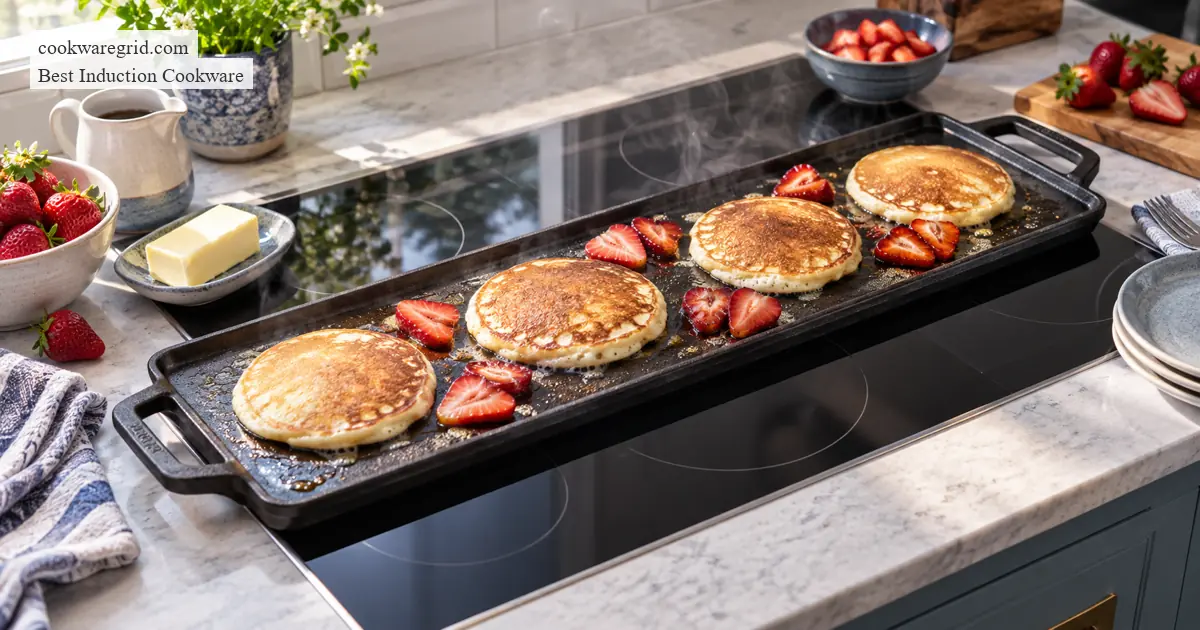
Quick answer: For one round zone, choose a compact cast iron griddle that stays within the coil. For two linked zones, use a bridge-compatible rectangular griddle with a flat ferrous base.
Use this guide to narrow the field before comparing price. The strongest best induction griddle choice is not simply the heaviest or most expensive option; it is the one whose base size, construction, and handling fit the burner and the food you cook most often.
For a broader comparison of complete sets and materials, start with our top rated induction cookware guide. Then use the measurements and checks below to match the vessel to your cooktop and cooking style.
Editorial shortlist
Strong best induction griddle Options to Compare
These established product lines provide useful starting points based on published construction and compatibility information. Confirm the current model, dimensions, and warranty before buying; this list does not claim hands-on test results that have not been recorded.
1. Lodge Single-Burner Reversible Griddle
Compare its magnetic base diameter, weight, handles, heat-spreading construction, and current manufacturer specifications against your cooktop.
2. Lodge Pro-Grid Reversible Griddle
Compare its magnetic base diameter, weight, handles, heat-spreading construction, and current manufacturer specifications against your cooktop.
3. Made In Carbon Steel Griddle
Compare its magnetic base diameter, weight, handles, heat-spreading construction, and current manufacturer specifications against your cooktop.
Buying Guides
Zone layout: What It Changes on Induction
A long griddle needs a true bridge or flex zone; coils heat only the metal directly above them.
Induction generates heat in the magnetic portion of the cookware rather than heating the glass first. That makes zone layout directly relevant to how quickly the vessel is detected, where energy enters the base, and how well that energy reaches food beyond the coil. Consider it alongside flatness; one strong specification cannot cancel out a poor physical match.
How to check it
Read the cooktop manual for bridge-zone placement. Record what changes when you use a better-matched zone or a lower preheat setting; a repeatable improvement is more useful than a one-time visual impression.
Buying Guides
Flatness: What It Changes on Induction
A bowed griddle can rock, lose detection, and spread heat poorly.
Look at the usable cooking surface and the underside of the vessel, not only the diameter or material printed on the box. Flatness becomes meaningful when the pan is centered over a suitable zone and carries a realistic food load. A cold-pan inspection followed by moderate-power cooking reveals more than an aggressive empty-pan test.
How to check it
Preheat on medium across both zones. Record what changes when you use a better-matched zone or a lower preheat setting; a repeatable improvement is more useful than a one-time visual impression.
Buying Guides
Thermal mass: What It Changes on Induction
Cast iron smooths short power pulses but heats slowly; carbon steel responds faster and weighs less.
In everyday cooking, thermal mass shows up through control and consistency: how readily the pan responds when power changes, whether the perimeter keeps pace with the center, and whether the vessel remains stable on glass. Compare those observations with surface before deciding that the cooktop itself is responsible.
How to check it
Rotate food rather than continually moving the griddle. Record what changes when you use a better-matched zone or a lower preheat setting; a repeatable improvement is more useful than a one-time visual impression.
Buying Guides
Surface: What It Changes on Induction
Smooth plates suit pancakes and eggs, while ridges produce grill marks but reduce food contact.
Treat surface as part of a heat-management routine. Begin below maximum power, allow the base time to equalize, and watch the food rather than relying only on the numbered setting. This is especially important when a broad pan sits over a smaller coil or when little food is available to absorb concentrated energy.
How to check it
Use two handles for safe lifting. Record what changes when you use a better-matched zone or a lower preheat setting; a repeatable improvement is more useful than a one-time visual impression.
Decision checklist
How to Apply This Guide in Your Kitchen
- Read the cooktop manual for bridge-zone placement.
- Preheat on medium across both zones.
- Rotate food rather than continually moving the griddle.
- Use two handles for safe lifting.
Test cookware cold and clean, then use moderate power with food or liquid present. Avoid prolonged empty boost heating and sudden cold-water cooling, two habits that amplify warping and coating damage.
FAQ
Best Griddles for Induction Cooktops FAQ
Can a griddle span two induction burners?
Yes, but even results normally require a cooktop bridge or flex-zone function designed to link both coils.
Is cast iron or carbon steel better?
Cast iron retains more heat; carbon steel is easier to lift and responds faster.
Why are there cold strips on my griddle?
The metal between separate coils may receive less energy, especially without a bridge zone.
Sources and Further Reading
CookwareGrid uses manufacturer guidance, appliance documentation, and authoritative food-safety resources where applicable. Product specifications can change.
About Leamon Warner
Leamon Warner is a kitchen expert, researcher, and founder of CookwareGrid with more than 25 years of experience in the kitchen and home-goods industry. His background includes cookware research, product testing, and work with LG, Lamacom Group, and Fleur Metal.