Care & Troubleshooting
Hot Spots on Induction: 8 Causes and Practical Fixes
Hot spots on induction usually appear when the active coil is smaller than the pan, the magnetic footprint is partial, or the cookware cannot spread concentrated energy quickly enough. Technique can reduce the symptom; construction determines the ceiling.

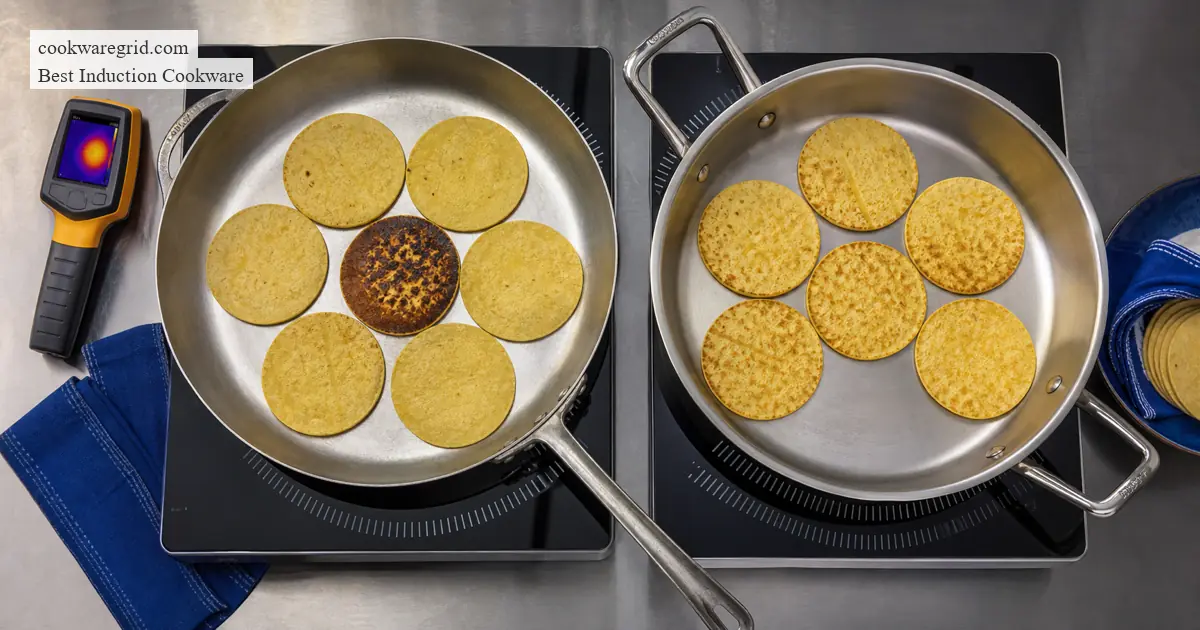
Fast diagnosis: if food browns in a ring or dark center, lower preheat power, match the pan to a larger zone, check base flatness, and compare results with thicker fully clad cookware.
Induction feels uniformly powerful because it reacts quickly, but the magnetic field is not necessarily as wide as the printed ring on the glass. A broad skillet may receive most of its energy in a much smaller circle. Thick aluminum or copper layers spread that energy; thin steel reveals it.
This article is a diagnostic companion to why induction pans heat unevenly. Here, the focus is identifying the shape of a hot spot and choosing the most efficient fix.
Diagnosis
Eight Reasons Induction Cookware Develops Hot Spots
The first four causes are geometry: an active coil smaller than the pan, a magnetic plate smaller than the pan, an off-center vessel, and a warped base. Each concentrates or shifts where energy enters. The next three are construction: a thin steel body, too little conductive aluminum or copper, and a poorly bonded layered base.
The eighth cause is technique: applying boost or high power to a cold, empty pan. Energy enters faster than the cookware can spread it, so the coil pattern becomes a temperature pattern. Food added at that moment browns according to the hot ring rather than the full surface.
Multiple causes can overlap. A thin, slightly warped skillet on a small portable burner is a worst-case combination. Replacing only one variable may improve the result without making it fully even.
- Active induction coil is smaller than the pan.
- Magnetic disc covers only the center of the base.
- Pan is not centered over the zone.
- Base is convex, twisted, or otherwise warped.
- Steel cooking surface is too thin.
- Conductive core is too thin or ends near the base.
- Layers or bonded disc spread heat poorly.
- Empty high-power preheating outruns lateral heat diffusion.
Simple tests
How to Map the Hot Area Without Special Equipment
For a food-based test, arrange small flour tortillas or evenly cut bread pieces across a lightly oiled pan and heat at a moderate setting. Note which pieces color first. Pancakes can reveal the same pattern but add batter-thickness variation, so use equal portions.
A water test is less useful for mapping because convection moves hot water around. A thin layer can show where bubbles begin, but it does not represent dry searing. Infrared thermometers can help on matte surfaces, yet shiny stainless produces unreliable readings unless emissivity is controlled.
Repeat the test after rotating the pan 180 degrees. If the hot patch rotates with the pan, cookware construction or warping is the likely source. If the patch stays fixed over the cooktop, zone geometry, placement, or the appliance deserves attention.
No-cost fixes
Technique Changes That Reduce Induction Hot Spots
Preheat at medium or medium-low power for longer instead of using boost. The extra time allows aluminum or copper layers to move heat outward before food arrives. Center the magnetic footprint, not just the flared rim, over the zone.
Choose the largest appropriate zone and keep the pan within the appliance’s size guidance. For wide-surface tasks, rotate or move food during the early cooking stage. A small burner can still boil a large pot because moving liquid distributes energy, but it is less suited to browning a full 12-inch skillet.
Add oil after the pan begins warming but before it becomes excessively hot. If you use stainless steel, our stainless steel preheating guide explains a controlled sequence that supports release without overheating the center.
Construction
Which Cookware Spreads Induction Heat More Evenly?
Fully clad stainless with a substantial aluminum or copper core is a strong general solution because the conductive layer extends across the base and often up the sides. A thick, broad disc base can also work well, especially for saucepans and stockpots, but a narrow disc is less convincing in a wide skillet.
Cast iron retains heat but is not automatically even; its thermal conductivity is modest, so a large skillet over a small coil may still show a center hot spot. Carbon steel has similar geometry concerns and is often thinner. Thickness helps moderate temperature swings, but matching the pan to the zone remains essential.
Compare fully clad vs disc-bottom induction cookware and tri-ply vs 5-ply cookware before assuming that a higher ply count alone guarantees evenness.
Escalation
How to Tell Whether the Pan or Cooktop Is at Fault
Test two flat induction-compatible pans of different construction on the same zone, then test the better pan on another zone. If every pan shows the same one-sided problem on one burner, the appliance may need service. If only one pan reproduces the issue across zones, the cookware is the stronger suspect.
Check the manual for minimum pan diameter, flex-zone placement, and power-sharing behavior. Some cooktops reduce or pulse power when adjacent zones operate together. That cycling can affect browning without indicating a fault.
Stop using a pan with severe rocking, delamination, a loose bonded disc, or localized base damage. For detection errors as well as heat problems, see why an induction cooktop is not detecting a pan.
FAQ
Hot Spots on Induction: Causes and Fixes FAQ
Direct answers to the practical questions readers ask most often.
Why is the middle of my induction pan hotter?
The active coil or magnetic base is often smaller than the cooking surface, and the pan does not spread that concentrated heat fast enough.
Does 5-ply cookware eliminate induction hot spots?
Not automatically. Layer materials, thickness, magnetic footprint, flatness, and burner size matter more than the ply number by itself.
Can cast iron have hot spots on induction?
Yes. Cast iron retains heat well but spreads it relatively slowly, so a large skillet on a small induction coil can still develop a hot center.
Should I use boost to preheat a skillet?
Usually not for wide-surface cooking. Moderate power gives the pan more time to spread heat and reduces the chance of scorching the coil area.
Editorial references
Sources and Further Reading
- Bosch induction manual: base construction and even heat distribution
- Bosch: induction troubleshooting and cookware placement
CookwareGrid uses manufacturer documentation and primary public guidance to verify technical and safety claims. Product instructions for your exact cookware and cooktop take priority over general advice.
About Leamon Warner
Leamon Warner is a kitchen expert, researcher, and founder of CookwareGrid with more than 25 years of experience in the kitchen and home-goods industry. His background includes work with LG, Lamacom Group, and Fleur Metal, alongside cookware research, product testing, and conversations with industry experts. He created CookwareGrid to turn that experience into clear, practical advice for home cooks.