Care & troubleshooting
Why Induction Pans Heat Unevenly and How to Fix It
Uneven induction heating usually comes from a mismatch between the burner, the pan base, and the way the cookware spreads heat after the magnetic field activates it. The cooktop is powerful, but it cannot turn a thin, warped, or badly matched pan into a perfectly even cooking surface.

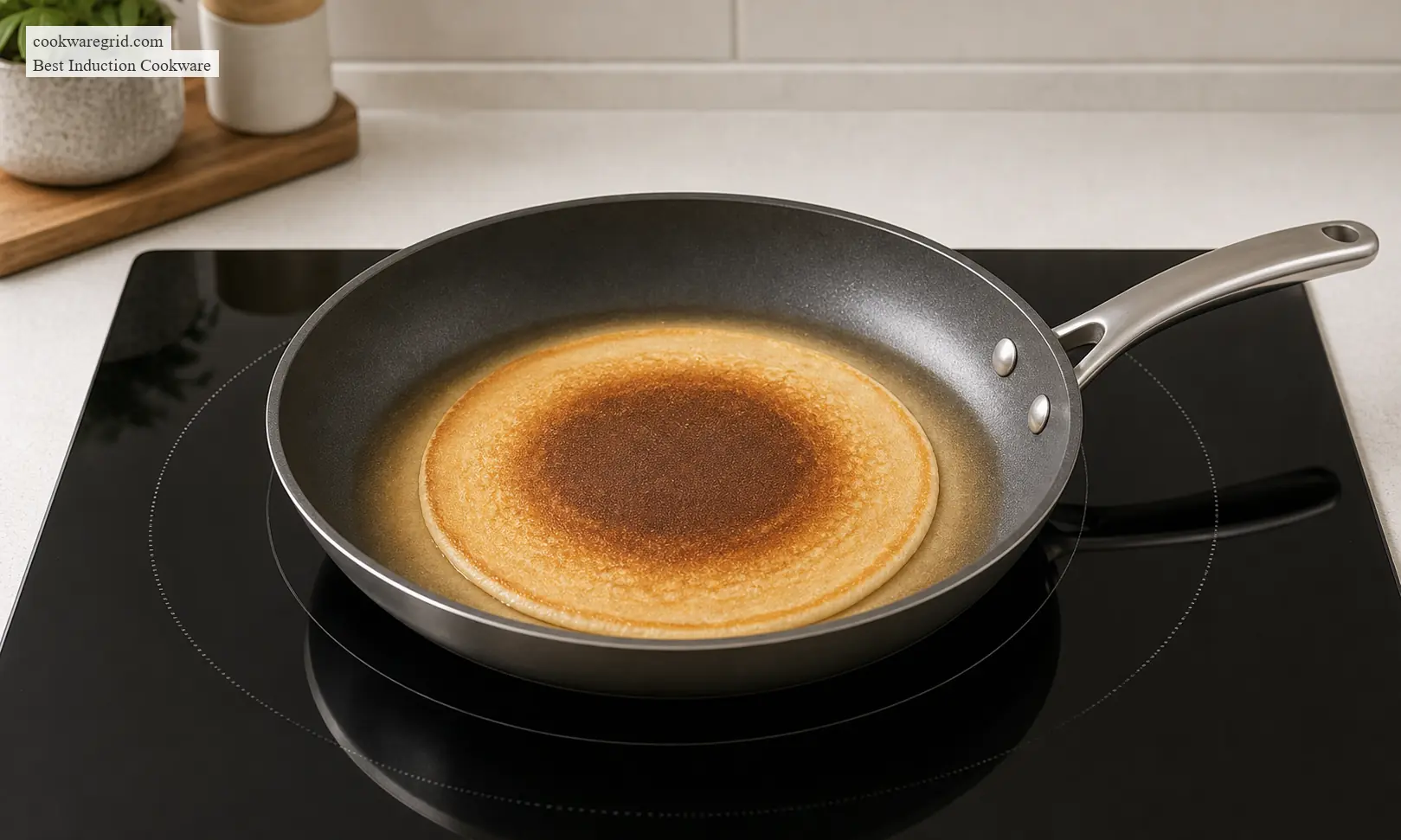
If the center of the pan is racing ahead of the edges, start by checking base size, flatness, and pan construction. Lowering the preheat power slightly helps, but better cookware architecture often helps more.
This topic connects directly to why induction cookware needs a flat bottom, induction cookware warping, fully clad vs disc bottom induction cookware, and how to preheat stainless steel on induction. Uneven heating is rarely just one thing.
Diagnosis
The Main Reasons Induction Pans Heat Unevenly
The first cause is burner mismatch. If the active induction zone is much smaller than the cooking surface you are trying to use, the center heats first and the outer area depends on the pan to spread that energy. Thin or weakly built pans struggle there.
The second cause is base shape. If the pan is not flat, contact becomes inconsistent and the hot zone can feel even more concentrated. The third cause is construction. Cheap or thin cookware often lacks enough conductive mass to smooth out the coil pattern.
Material matters too. A well-built clad stainless pan with an aluminum core generally spreads heat better than a thin magnetic pan with very little conductive help.
Fixes
How to Improve Heat Distribution on Induction
Start by lowering the power one step during preheat. This sounds small, but it gives the pan more time to spread heat before the center outruns the edges. Next, match the pan base to the burner more closely. Wide skillets on small portable induction units are especially vulnerable to uneven heating.
Use pans with stronger construction for wide-surface tasks. That often means better clad stainless, thicker carbon steel, or premium multi-ply cookware rather than the thinnest budget option. If you are still shopping, compare tri-ply vs 5-ply induction cookware and best materials for induction cookware.
- Use moderate preheat instead of instant maximum power.
- Match base diameter to the active induction zone.
- Choose cookware with better conductive layers.
- Check for warp or rocking before blaming the recipe.
Buying
Which Pans Usually Heat More Evenly?
Fully clad stainless steel is usually the safest all-around answer because it combines a magnetic exterior with an aluminum or copper core that helps move heat past the center. Better disc-bottom pans can be fine for pots, but they are less convincing for skillets where edge-to-center consistency matters more.
Thicker carbon steel and cast iron can work well too, but they bring weight and different heat behavior. If you are cooking in stainless and also struggling with sticking, our food sticking to stainless steel on induction guide covers the technique side of the equation.
Decision
When to Replace the Pan Instead of Fighting It
If the pan rocks, buzzes excessively, discolors quickly in one zone, or repeatedly cooks patchily even after you adjust technique, replacement can be the rational answer. Not every induction problem is solved with patience. Some cookware simply does not have the base quality or conductive structure to perform well on modern induction burners.
If you are ready to upgrade, use top rated induction cookware as the broad benchmark and then narrow down by material and cooking style.
FAQ
Why Induction Pans Heat Unevenly FAQ
Short answers for the hot-spot and heat-spread questions that show up most often.
Why is the center of my induction pan hotter than the edges?
This usually happens when the induction zone is smaller than the working base, when the pan is thin, or when the conductive layers do not spread heat well beyond the coil.
Can a warped pan cause uneven induction heating?
Yes. If the base is not making consistent contact with the glass, the cooktop can transfer heat unevenly and the pan can brown in patches.
How do I fix uneven heating on an induction cooktop?
Match the pan to the burner, use cookware with a flatter and better-built base, lower the power slightly during preheat, and avoid thin or damaged pans for wide-surface cooking.
About Leamon Warner
Leamon Warner is a kitchen expert, researcher, and founder of CookwareGrid with more than 25 years of experience in the kitchen and home-goods industry. His background includes work with LG, Lamacom Group, and Fleur Metal, alongside cookware research, product testing, and conversations with industry experts. He created CookwareGrid to turn that experience into clear, practical advice for home cooks.