Cookware Lessons
Induction Cookware Size Guide: Match Pan Diameter to Burner Size
Measure the flat magnetic base, not the upper rim. For the strongest detection and most even results, use a base close to the marked cooking-zone diameter and follow the appliance minimum-size guidance.

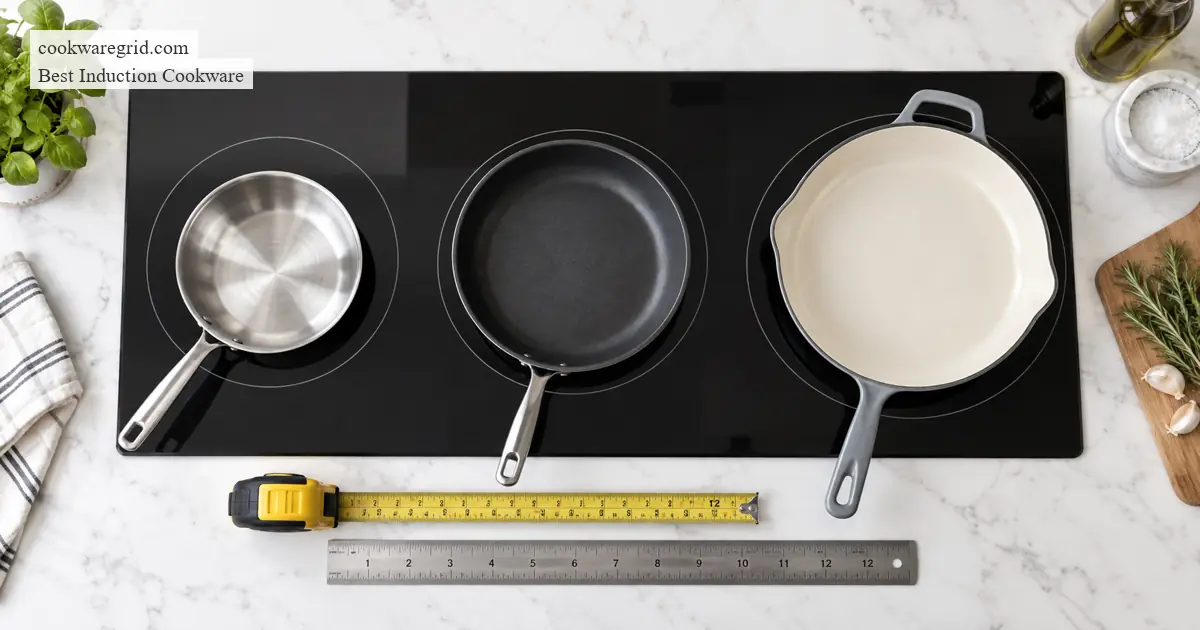
Quick answer: Measure the flat magnetic base, not the upper rim. For the strongest detection and most even results, use a base close to the marked cooking-zone diameter and follow the appliance minimum-size guidance.
Induction compatibility is a system: the pan, coil, controls, and cooking load all influence the result. Understanding how those parts interact makes specifications easier to interpret and prevents a magnet test from becoming the only buying criterion.
For a broader comparison of complete sets and materials, start with our top rated induction cookware guide. Then use the measurements and checks below to match the vessel to your cooktop and cooking style.
Cookware Lessons
Base versus rim: What It Changes on Induction
Manufacturers often list rim diameter, which can be much larger than the magnetic footprint.
Induction generates heat in the magnetic portion of the cookware rather than heating the glass first. That makes base versus rim directly relevant to how quickly the vessel is detected, where energy enters the base, and how well that energy reaches food beyond the coil. Consider it alongside minimum detection; one strong specification cannot cancel out a poor physical match.
How to check it
Turn the pan over and measure the flat magnetic disc. Record what changes when you use a better-matched zone or a lower preheat setting; a repeatable improvement is more useful than a one-time visual impression.
Cookware Lessons
Minimum detection: What It Changes on Induction
A small pan may not cover enough of the coil for the electronics to recognize it.
Look at the usable cooking surface and the underside of the vessel, not only the diameter or material printed on the box. Minimum detection becomes meaningful when the pan is centered over a suitable zone and carries a realistic food load. A cold-pan inspection followed by moderate-power cooking reveals more than an aggressive empty-pan test.
How to check it
Compare it with the zone diagram in the manual. Record what changes when you use a better-matched zone or a lower preheat setting; a repeatable improvement is more useful than a one-time visual impression.
Cookware Lessons
Oversizing: What It Changes on Induction
A large pan can activate yet develop a hot ring because the coil energizes only its center.
In everyday cooking, oversizing shows up through control and consistency: how readily the pan responds when power changes, whether the perimeter keeps pace with the center, and whether the vessel remains stable on glass. Compare those observations with positioning before deciding that the cooktop itself is responsible.
How to check it
Use a magnet to map partial ferrous bases. Record what changes when you use a better-matched zone or a lower preheat setting; a repeatable improvement is more useful than a one-time visual impression.
Cookware Lessons
Positioning: What It Changes on Induction
Centering keeps the magnetic base over the sensor and active coil.
Treat positioning as part of a heat-management routine. Begin below maximum power, allow the base time to equalize, and watch the food rather than relying only on the numbered setting. This is especially important when a broad pan sits over a smaller coil or when little food is available to absorb concentrated energy.
How to check it
Record the useful base size before buying replacements. Record what changes when you use a better-matched zone or a lower preheat setting; a repeatable improvement is more useful than a one-time visual impression.
Decision checklist
How to Apply This Guide in Your Kitchen
- Turn the pan over and measure the flat magnetic disc.
- Compare it with the zone diagram in the manual.
- Use a magnet to map partial ferrous bases.
- Record the useful base size before buying replacements.
Test cookware cold and clean, then use moderate power with food or liquid present. Avoid prolonged empty boost heating and sudden cold-water cooling, two habits that amplify warping and coating damage.
FAQ
Induction Cookware Size Guide FAQ
Should pan size match the printed ring?
Ideally, the magnetic base should be close to the active zone diameter, subject to the cooktop manual.
Do cookware sizes describe the base?
Usually not. Frying-pan sizes commonly describe the upper rim.
Can one pan work differently on two zones?
Yes. Zones can have different coil diameters and minimum detection thresholds.
Sources and Further Reading
CookwareGrid uses manufacturer guidance, appliance documentation, and authoritative food-safety resources where applicable. Product specifications can change.
About Leamon Warner
Leamon Warner is a kitchen expert, researcher, and founder of CookwareGrid with more than 25 years of experience in the kitchen and home-goods industry. His background includes cookware research, product testing, and work with LG, Lamacom Group, and Fleur Metal.