Care & Troubleshooting
Why Your Pan Slides Around on an Induction Cooktop (and How to Stop It)
A pan usually slides on induction because the glass and base are unusually smooth, the cookware is lightweight or handle-heavy, or moisture and grease reduce friction. Rocking, spinning, or drifting can also reveal a warped base.

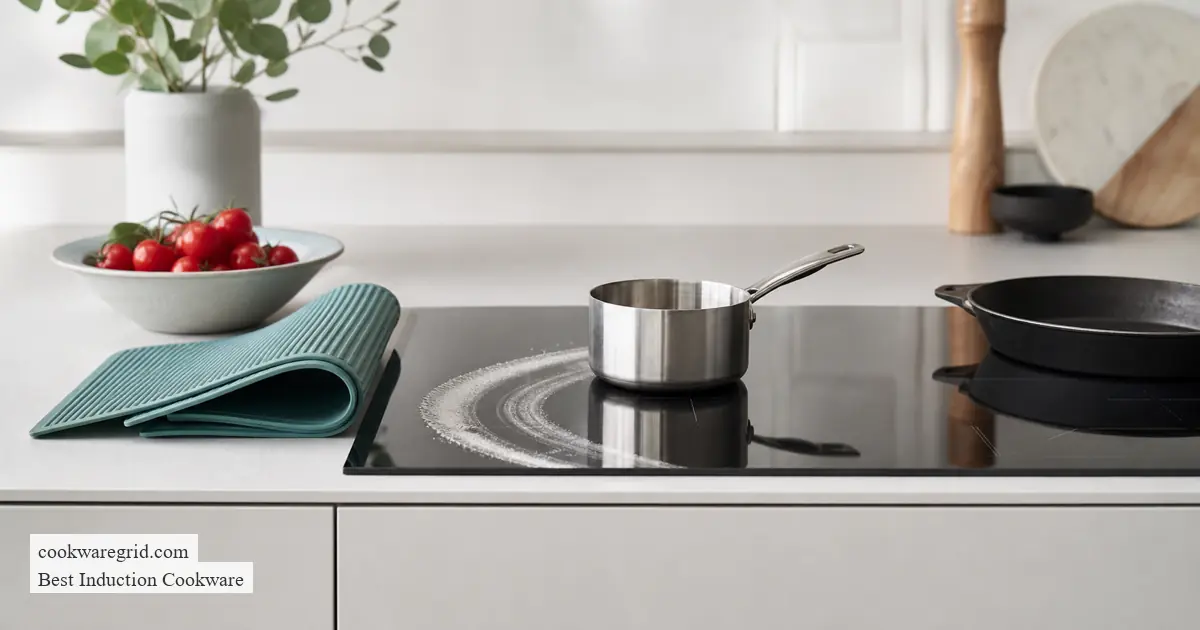
Quick fix: turn the zone off, let it cool, clean and dry both surfaces, center the pan, rotate the handle away from traffic, and use a stable flat-bottom pan that matches the zone.
Induction glass is designed to be flat and easy to clean. A smooth pan base on that smooth surface can have surprisingly little resistance, especially when stirring pulls sideways on a long handle. Unlike a gas grate, there are no raised supports to hold the cookware in place.
The solution depends on whether the pan is merely slick or structurally unstable. A pan that glides as one flat unit needs a different fix from one that rocks on a high center. For base-shape fundamentals, read why induction cookware needs a flat bottom.
Root causes
The Most Common Reasons a Pan Moves on Induction
Lightweight cookware is easiest to move because stirring force and handle weight represent a larger share of the pan’s total mass. Small saucepans with long metal handles can rotate even when their bases are flat. A pan that is almost empty is more likely to shift than the same pan filled with food.
A film of oil, cleaner, condensation, or rinse water can make the interface more slippery. Granular debris can create the opposite problem: it may catch and scratch as the pan moves. Both the glass and pan base should be cool, clean, and dry before cooking.
Warping creates a pivot point. A convex base can spin around its center; a twisted base may rock between two high points. Uneven feet, embossed rings, or a very small magnetic disc can also make a pan feel less planted than a broad flat base.
- Very light pan or nearly empty vessel.
- Long, heavy handle pulling the pan off center.
- Grease, moisture, or cleaner residue on the glass.
- Convex, warped, or uneven cookware base.
- Stirring or tossing with strong lateral force.
Two-minute test
How to Check Whether the Pan Is Warped
When the cookware is completely cool, place it on a known-flat countertop or the unpowered cooktop. Press gently at several points around the rim. A stable pan should not click or rock. Look across the bottom at eye level for daylight beneath the edges, then rotate the pan and repeat.
A slight engineered concavity can flatten as cookware warms, so visual inspection alone is not always decisive. The bigger warning is repeatable instability during normal cooking, especially if the pan also creates uneven browning or a concentrated hot center.
Thermal shock and empty boost preheating are common warp triggers. Our induction cookware warping guide explains prevention, while why induction pans heat unevenly connects base geometry with cooking results.
Stability
Safe Ways to Stop a Pan Sliding
Start with cleaning. Use the cooktop maker’s approved cleaner, remove all residue, and dry the glass. Wash the pan base and feel for baked-on spots or burrs. Center the magnetic footprint over the zone and turn the handle toward the side or rear, where it will not be bumped.
Use a spoon or spatula that lets you stir downward rather than dragging sideways. Hold the cool handle when a recipe needs vigorous mixing. Adding ingredients before aggressive stirring also gives a lightweight pan more stabilizing mass.
If movement persists, choose a heavier pan with a broad flat base and balanced handle. You do not need the heaviest cast iron available; well-built clad stainless or thick aluminum with an induction plate often offers enough stability without excessive glass-top weight.
Avoid
Do Not Improvise a Barrier Under an Active Pan
Online advice sometimes recommends paper towels, parchment, cloth, shelf liner, or generic silicone mats under cookware. These materials can trap heat, scorch, move, melt, or interfere with temperature sensing. An induction surface may stay cooler than a radiant element, but heat conducted back from the pan can still make the glass and anything touching it very hot.
Some appliance manufacturers sell or approve specific protective accessories for defined models. That is different from assuming any heat-resistant sheet is safe. Check the manual and use only an accessory explicitly approved for cooking between the pan and that cooktop.
Do not use adhesive anti-slip dots on the base, and do not grind or sand cookware unless the manufacturer directs it. Modifying the bottom can remove coatings, expose metal, worsen flatness, and void warranties.
Decision
When Sliding Means the Pan Should Be Replaced
Replace the pan when it rocks significantly, rotates around a visibly bowed center, has a loose handle, or moves unpredictably during ordinary stirring. Instability near boiling liquids or hot oil is a burn risk, not merely an annoyance.
If the base is flat and the pan is simply too light for your technique, you can reserve it for low-stir tasks and choose a more stable skillet or saucepan for everyday work. Our best induction cookware for glass cooktops guide prioritizes smooth bases, manageable weight, and warp resistance.
FAQ
Pan Slides Around on an Induction Cooktop FAQ
Direct answers to the practical questions readers ask most often.
Why does my pan spin on an induction cooktop?
A convex or warped base often creates a central pivot point. Lightweight cookware and a long unbalanced handle can make the spinning more noticeable.
Can I put a silicone mat under an induction pan?
Only if the cooktop manufacturer explicitly approves that mat and use for your model. Generic mats can trap heat, move, or interfere with normal operation.
Will a heavier pan stop sliding?
Often, yes, provided the heavier pan has a broad flat base. Balance and flatness matter as much as total weight.
Can moisture make cookware slide on glass?
Yes. Water, grease, and cleaning residue can reduce friction. Turn the zone off and clean and dry both surfaces before continuing.
Editorial references
Sources and Further Reading
- Bosch: induction troubleshooting and cookware flatness
- CookwareGrid: preventing scratches on induction glass
CookwareGrid uses manufacturer documentation and primary public guidance to verify technical and safety claims. Product instructions for your exact cookware and cooktop take priority over general advice.
About Leamon Warner
Leamon Warner is a kitchen expert, researcher, and founder of CookwareGrid with more than 25 years of experience in the kitchen and home-goods industry. His background includes work with LG, Lamacom Group, and Fleur Metal, alongside cookware research, product testing, and conversations with industry experts. He created CookwareGrid to turn that experience into clear, practical advice for home cooks.