Care & Troubleshooting
Does Induction Ruin Nonstick Coatings Faster? How to Prevent Wear
Induction does not chemically attack a nonstick coating. The real risk is speed: a thin, empty magnetic-base pan can overheat very quickly, and repeated overheating is one of the fastest ways to shorten the useful life of PTFE or ceramic nonstick.

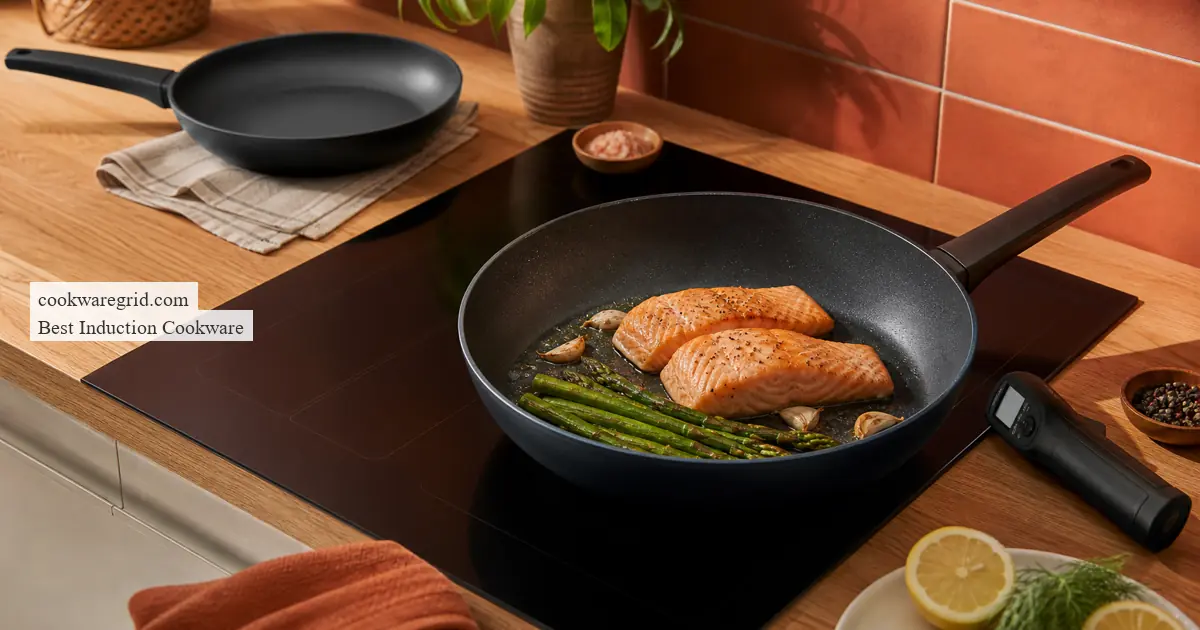
Short answer: induction need not wear nonstick faster when you use low-to-medium power, preheat briefly, add food or fat promptly, and avoid boost with an empty pan.
Induction can move from cold to cooking temperature with very little delay. That responsiveness is useful, but it removes the long warning period many cooks expect from gas or radiant electric. A pan can be too hot before oil shimmers, butter enters, or food is ready.
Nonstick durability therefore depends heavily on control habits and pan construction. This guide applies to complete sets and individual skillets. For product selection, see best nonstick induction cookware and best nonstick induction pans.
Coating life
What Actually Wears Out a Nonstick Coating
Heat, abrasion, residue, and time are the main variables. Repeated overheating can weaken a coating, discolor the surface, and reduce food release. Metal utensils, abrasive pads, stacked-pan contact, and dishwasher chemistry can add physical or chemical wear. Burned oil can also form a film that makes an intact pan feel sticky.
None of those mechanisms is unique to induction. A gas burner can overheat a pan, and a radiant element can keep feeding heat after the control is lowered. Induction simply makes temperature rise faster in a compatible magnetic base, particularly when the pan is empty and thin.
Manufacturers commonly advise low or medium heat for nonstick and warn against prolonged empty preheating. Tefal, for example, identifies overheating, scratching, and abrasive cleaning as common evidence in worn nonstick surfaces. Follow the exact maker’s temperature and utensil instructions because formulations and base designs differ.
Fast heat
Why Induction Can Expose Bad Nonstick Habits Faster
A magnetic steel plate can heat before the aluminum body and coating have equalized. At boost power, that localized energy may produce a hot ring or center beneath an apparently cool-looking pan. Lightweight cookware is especially vulnerable because it has less thermal mass to slow the rise.
Pan-to-zone mismatch increases the problem. A large skillet on a small active coil may overheat in the center while the perimeter remains cooler. Cooks then raise power to improve edge browning, making the center still hotter. A thicker aluminum body and a magnetic footprint close to the cooking diameter reduce this gradient.
Induction also responds instantly when you lower the setting, but the pan retains heat. Treat the control change as stopping new energy, not instantly cooling the coating. Move the pan off the zone when it has clearly overshot.
Better habits
How to Protect Nonstick Cookware on Induction
Begin at low or medium-low power and preheat only long enough to prepare the surface for the food. For eggs and delicate fish, oil or butter can go in early and act as a visual temperature cue. If fat smokes, the pan is already hotter than needed for most nonstick cooking.
Match the pan base to the zone, avoid boost, and do not leave the pan unattended. Use silicone, wood, or manufacturer-approved utensils. Let the pan cool naturally before washing; cold water on a very hot base can warp the metal, causing unstable contact and uneven future heating.
Hand washing with a soft sponge is the conservative choice even when a pan is labeled dishwasher safe. Remove residue fully, because an invisible film of cooked oil can reduce release. Our guides to cleaning induction cookware and preventing cookware warping cover both problems.
- Skip boost and prolonged empty preheating.
- Use the smallest power level that cooks effectively.
- Keep the pan centered over a similar-size zone.
- Use soft utensils and nonabrasive cleaning tools.
- Cool gradually before adding wash water.
Material choice
PTFE and Ceramic Nonstick Behave Differently
PTFE-based nonstick generally offers excellent release and can retain it well when used within the maker’s temperature limits. Ceramic nonstick is typically marketed as PFAS-free and can feel extremely slick when new, but release may decline as the surface accumulates residue and ages.
Neither category benefits from maximum induction power. Ceramic coatings may tolerate a manufacturer-specified high temperature, yet unnecessary heat can still accelerate loss of easy release. PTFE cookware should never be overheated or used beyond its stated limit. Marketing terms such as “diamond,” “granite,” or “titanium” do not replace the actual coating specification.
For a direct comparison, read ceramic vs Teflon induction cookware and ceramic nonstick vs stainless steel.
Inspection
When a Nonstick Induction Pan Should Be Replaced
Replace cookware when the coating is peeling, flaking, deeply scratched, blistered, or separating from the base. A pan that has become severely warped or rocks on the cooktop also deserves retirement because it can heat unpredictably and slide.
Sticking alone is not always proof of coating failure. First remove residue with the manufacturer-approved cleaning method and try a moderate-heat cook with a small amount of fat. If release remains poor and the surface is visibly worn, replacement is more reasonable than increasingly aggressive cleaning.
Buy the replacement with realistic expectations. All coatings are consumable surfaces. A stable, thick induction base and careful heat control can extend useful life, but neither turns nonstick into lifetime cookware.
FAQ
Does Induction Ruin Nonstick Coatings Faster? FAQ
Direct answers to the practical questions readers ask most often.
Does induction heat damage PTFE nonstick?
Not during normal use within the manufacturer’s limits. Rapid empty overheating and repeated high-power cooking can damage or shorten the life of PTFE nonstick.
Is ceramic nonstick safer to use on induction boost?
No. PFAS-free ceramic still does not benefit from prolonged empty high heat, and excessive temperature can reduce its release performance.
What induction setting should I use for nonstick?
Start at low to medium power. Exact numbers vary by cooktop, pan, and food, so use the manufacturer’s guidance and visual cues rather than a universal setting.
Why did my nonstick pan become sticky?
Common causes include overheated coating, burned-on oil residue, abrasion, dishwasher wear, or normal aging. Clean it gently before deciding the coating has failed.
Editorial references
Sources and Further Reading
- Tefal: nonstick cookware use, overheating, and care
- FDA: food-contact substances and safety assessment
CookwareGrid uses manufacturer documentation and primary public guidance to verify technical and safety claims. Product instructions for your exact cookware and cooktop take priority over general advice.
About Leamon Warner
Leamon Warner is a kitchen expert, researcher, and founder of CookwareGrid with more than 25 years of experience in the kitchen and home-goods industry. His background includes work with LG, Lamacom Group, and Fleur Metal, alongside cookware research, product testing, and conversations with industry experts. He created CookwareGrid to turn that experience into clear, practical advice for home cooks.