Materials & Compatibility
Does Aluminum Cookware Work on Induction? The Magnetic-Base Rule
Bare aluminum does not normally work on induction because it is not ferromagnetic. Aluminum cookware can still be induction compatible when the maker bonds a sufficiently large magnetic stainless steel plate or outer layer to the base.

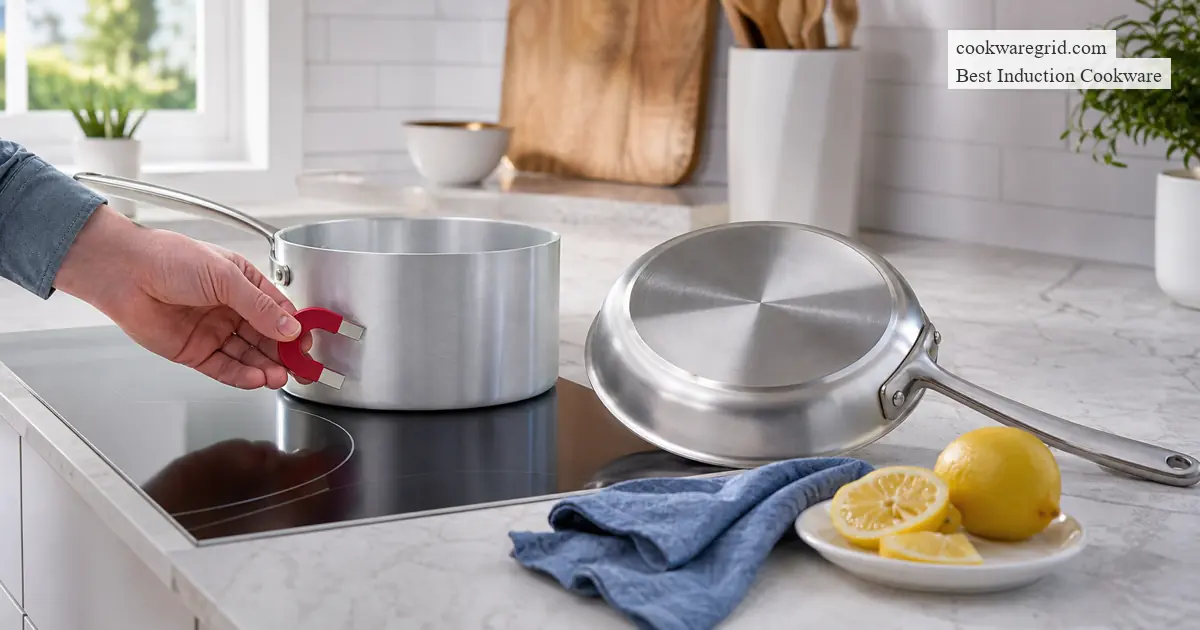
Short answer: pure aluminum will not activate a standard induction zone, but many aluminum pans are made for induction by adding a magnetic steel base. Check the induction symbol and confirm with a firm magnet test.
Aluminum is one of the most useful cookware metals because it is light, affordable, and highly conductive. Those strengths explain why it appears inside so many stainless steel and nonstick pans. They do not, however, make the metal magnetic. A standard induction cooktop needs a ferromagnetic layer that couples with the alternating magnetic field beneath the glass.
That distinction is easy to miss. A pan can be marketed as “hard-anodized aluminum” or “forged aluminum” and still fail on induction unless its construction includes a compatible base. For the broader material picture, see our guides to what makes cookware induction compatible and the induction cookware magnet test.
The science
Why Bare Aluminum Does Not Activate an Induction Burner
An induction coil produces a rapidly changing magnetic field. Compatible cookware converts that field into heat through electrical currents and magnetic losses in the pan base. Iron-rich materials such as cast iron, carbon steel, and magnetic stainless steel couple efficiently with the field. Aluminum conducts electricity and heat very well, but it is not ferromagnetic, so an ordinary induction hob generally will not recognize a bare aluminum pan.
This does not make aluminum a poor cookware material. It makes aluminum a poor outer induction layer. Inside a pan, aluminum is excellent at spreading heat away from the concentrated coil. That is why clad stainless cookware often sandwiches an aluminum core between a stainless cooking surface and a magnetic stainless exterior.
A pan that fails detection may leave the zone display flashing, produce an error, or shut the burner off. An adapter plate can technically create heat for a nonmagnetic pan, but it adds another thermal step, slows response, wastes some of induction’s efficiency advantage, and can become extremely hot. Use one only when the cooktop manufacturer explicitly permits it.
Construction
How Induction-Compatible Aluminum Cookware Is Built
Most induction-ready aluminum pans use one of two designs. The first is an impact-bonded magnetic stainless steel disc attached to the bottom. The second is a full magnetic exterior layer that wraps the base and may continue up the sidewalls. Both can work; the important details are the size, continuity, and quality of the magnetic area.
A full-size bonded disc can be a practical choice for saucepans and stockpots because the cooking task is mostly liquid-based. In a frying pan, a disc that is much smaller than the upper cooking surface may create a hotter center and cooler perimeter. A thicker aluminum body helps spread that heat, while a thin body can reveal the coil pattern more clearly.
Hard anodizing changes the aluminum surface so it is harder and more corrosion resistant, but anodizing alone does not make the pan magnetic. Likewise, a nonstick coating does not determine compatibility. The answer is in the base construction, which is why our hard anodized vs stainless steel induction cookware comparison looks beyond the interior finish.
- Bonded magnetic disc: common, economical, and effective when it covers most of the base.
- Magnetic outer layer: often offers more uniform detection across the footprint.
- Aluminum body or core: spreads heat and keeps weight manageable.
- Coating or anodized finish: affects cooking and care, not magnetic compatibility.
At-home check
How to Tell Whether an Aluminum Pan Will Work
Start with the packaging or manufacturer page and look for the coil-shaped induction symbol or a direct compatibility statement. Then place a refrigerator magnet against the flat center of the outside base. A strong, immediate pull is a good sign. Move the magnet toward the edge: if attraction disappears far inside the pan’s working diameter, the active magnetic plate may be smaller than the visible base.
The magnet test predicts compatibility, not perfect performance. A weak attraction may still trigger some cooktops and fail on others because detection thresholds vary by zone size and manufacturer. The practical test is to center the empty pan on a correctly sized zone, add a small amount of water before applying power, and confirm that the zone detects it promptly. Never use a prolonged empty high-power test.
Also check flatness on a hard level surface. If the pan rocks, spins freely, or shows a visibly bowed base, it may make unstable contact and heat less evenly. Our guide to why induction cookware needs a flat bottom explains why geometry matters even though induction does not require direct resistance-style heat transfer.
Cooking results
Does Aluminum Heat Well on Induction?
A well-built induction-ready aluminum pan can be responsive and even. Aluminum’s thermal conductivity helps move energy laterally, so temperature changes reach more of the cooking surface than they would in a very thin steel pan. This makes aluminum-based nonstick skillets especially useful for eggs, fish, and moderate-heat cooking.
The weak point is often the junction between the magnetic plate and aluminum body. Small discs, thin bodies, or poor bonding can produce a pronounced hot center, buzzing, or long-term warping. Match the pan’s magnetic footprint to the burner, preheat at medium rather than boost, and avoid plunging a hot pan into cold water.
If even heat is the priority, compare the base diameter and body thickness rather than shopping by weight alone. For broader options, our guide to the best materials for induction cookware compares aluminum-core stainless, cast iron, carbon steel, and coated cookware.
Before buying
Aluminum Induction Cookware Buying Checklist
Choose a pan that states induction compatibility for the exact model and size. Product families sometimes mix base constructions, so do not assume every piece in a collection works on induction. Look for a broad, flat magnetic plate; a body thick enough to resist distortion; comfortable handles; and a coating or cooking surface suited to your heat habits.
For nonstick aluminum, confirm the maker’s heat and oven limits and plan to cook mostly at low to medium power. For uncoated aluminum, consider how often you prepare acidic or salty foods and follow the manufacturer’s care guidance. If long service life and high-heat searing matter more than light weight, magnetic clad stainless may be a better fit.
- Exact model explicitly states induction compatibility.
- Magnet grips firmly across most of the bottom.
- Base sits flat without rocking.
- Magnetic plate is close to the pan’s working diameter.
- Care and temperature limits match how you cook.
FAQ
Does Aluminum Cookware Work on Induction? FAQ
Direct answers to the practical questions readers ask most often.
Can hard-anodized aluminum cookware work on induction?
Yes, but only when it has an added magnetic stainless steel base or exterior. Hard anodizing by itself does not make aluminum induction compatible.
Will a magnet stick to aluminum cookware?
A magnet will not normally stick to bare aluminum. If it grips the bottom of an aluminum pan, it is attracting a bonded magnetic layer rather than the aluminum body.
Can I use an induction adapter plate with aluminum cookware?
Some cooktops permit adapter plates, but they slow response, add heat loss, and can become very hot. Check the cooktop manual before using one.
Is induction-ready aluminum good for even heating?
It can be. A thick aluminum body and broad magnetic base usually spread heat better than a thin pan with a small bonded disc.
Editorial references
Sources and Further Reading
CookwareGrid uses manufacturer documentation and primary public guidance to verify technical and safety claims. Product instructions for your exact cookware and cooktop take priority over general advice.
About Leamon Warner
Leamon Warner is a kitchen expert, researcher, and founder of CookwareGrid with more than 25 years of experience in the kitchen and home-goods industry. His background includes work with LG, Lamacom Group, and Fleur Metal, alongside cookware research, product testing, and conversations with industry experts. He created CookwareGrid to turn that experience into clear, practical advice for home cooks.